Pharma Excipients
No Result
View All Result
  • Login
  • Shop
  • News
    • Specials
      • Excipients for CBD
      • Excipients & 3D Printing
      • Infographics – The overview
      • GMP-certified excipient production sites
      • The Future of TiO2
      • Excipients in the COVID-19 Vaccines
      • BASF PVP-Iodine
      • RegXcellence™
      • BASF Parenteral Excipients
    • World Days – The overview
  • Excipient basics
    • Excipient Solutions for CBD
    • Inorganic Chemicals
      • Calcium Carbonate
      • Calcium Phosphates
      • Calcium Sulfate
      • Halites
      • Metallic Oxides
      • Silica
    • Organic Chemicals
      • Actual Sugars
      • Artificial Sweeteners
      • Carbohydrates
      • Cellulose
      • Cellulose Esters
      • Cellulose Ethers
      • CMC and Croscarmellose Sodium
      • Converted Starch
      • Dried Starch
      • Microcrystalline Cellulose
      • Modified Starch
      • Starch
      • Sugars
      • Sugar Alcohols
    • Petrochemicals
      • Acrylic Polymers
      • Glycols
      • Mineral Hydrocarbons
      • Mineral Oils
      • Mineral Waxes
      • Petrolatum
      • Polyethylene Glycol (PEG)
      • Povidones
      • Propylene Glycol
      • Other Petrochemical Excipients
    • Oleochemicals
      • Fatty Alcohols
      • Glycerin
      • Mineral Stearates
      • Pharmaceutical Oils
      • Other Oleochemical Excipients
    • Proteins
  • Applications
    • 3D Printing – Drug Carrier
      • 3D Printing
      • Binder
      • Coating
      • Colour / Color
      • Coating Systems and Additives
      • Controlled Release Excipient
      • DC excipient
      • Disintegrant / Superdisintergrant
      • Drug Carrier
    • Emulsifier – Glidant
      • Emulsifier
      • Excipient for Inhalation
      • Filler
      • Film former
      • Flavour / Flavor
      • Glidant
    • Lubricant – Preservative
      • Lubricant
      • Nanotechnology
      • Orally Dissolving Technology Excipient
      • Pellet
      • Plasticizer
      • Preservative
    • Solubilizer – Viscocity Agent
      • Solubilizer
      • Speciality Excipient
      • Surfactants
      • Suspension Agent
      • Sustained Release Agent
      • Sweeteners
      • Taste Masking
      • Topical Excipient
      • Viscocity Agent
  • Sources
    • Handbook of Pharmaceutical Excipients – 9th Edition
    • EINECS Numbers
    • Excipient DMF List
    • Excipient cGMP Certification Organisations
    • FDA Inactive Ingredient List
    • FDA GRAS Substances (SCOGS) Database
    • Excipient E-Numbers
    • Whitepapers / Publications
    • Contract Development|Contract Manufacturing
  • Suppliers
    Excipient Suppliers List
    BIOGRUND Logo
    Evonik Logo
    LI logo violet
    logo roquette
    ADM
    Armor Pharma
    Asahi KASEI
    Ashland
    BASF
    Beneo
    Captisol
    Clariant Logo
    Clariant
    Croda
    DFE Pharma
    Excipio Chemicals
    Fuji Chemical
    Gattefossé
    Gangwal
    IamFluidics
    IamFluidics
    IOI Oleo
    Ingredient Pharm
    JRS Pharma
    Kerry Logo
    Kerry
    KLK Oleo
    KLK Oleo
    Lipoid
    Lubrizol Life Science Health
    Lubrizol Life Science Health
    MAGNESIA
    MAGNESIA
    MEGGLE Excipients & Technology
    MEGGLE
    Nagase Viita
    Nagase Viita
    Nordic Bioproducts
    Nordic Bioproducts
    Pfanstiehl
    Pfanstiehl
    pharm-a-spheres
    pharm-a-spheres
    PMC Isochem
    PMC Isochem
    Seppic
    Seppic
    ShinEtsu
    ShinEtsu
    Sigachi
    Sigachi
    SPI Pharma
    SPI Pharma
    Südzucker
    Südzucker
    Vikram Thermo
    Vikram Thermo
    Zerion Pharma
    Zerion Pharma
    • A-B
      • ADM
      • ARMOR PHARMA
      • Ceolus™ & Celphere™
      • Ashland
      • BASF
      • Beneo – galenIQ
      • Biogrund
      • Budenheim
    • C-G
      • Captisol
      • Croda
      • Cyclolab
      • DFE Pharma
      • DuPont Pharma Solutions
      • Evonik
      • Fuji Chemical Industries
      • Gattefossé
      • Gangwal Healthcare
    • I-O
      • ingredientpharm
      • IOI Oleochemical
      • JRS Pharma
      • Kerry
      • KLK Oleo Life Science
      • Lactalis Ingredients Pharma
      • Lipoid
      • Dr. Paul Lohmann
      • Lubrizol
      • Magnesia
      • MEGGLE Excipients
      • Nagase Viita – Pharmaceutical Ingredients
      • Nordic Bioproducts Group
    • P-Z
      • Pfanstiehl
      • pharm-a-spheres
      • Pharma Line
      • PMC Isochem
      • Roquette Pharma
      • Seppic
      • Shin-Etsu
      • Sigachi Group
      • Südzucker AG
      • VIKRAM THERMO
      • Zerion Pharma
      • ZoomLab® – Your Virtual Pharma Assistant
  • Inquiries
    • Product Inquiry
    • Tailored Tableting Excipients
      • Tailored Film Coating
  • Events
    • Overview Pharmaceutical Webinars
    • Videos CPhI Frankfurt 2025
    • CPhI China 2024
    • ExciPerience – The great excipient event!
  • All4Nutra

No products in the cart.

  • Shop
  • News
    • Specials
      • Excipients for CBD
      • Excipients & 3D Printing
      • Infographics – The overview
      • GMP-certified excipient production sites
      • The Future of TiO2
      • Excipients in the COVID-19 Vaccines
      • BASF PVP-Iodine
      • RegXcellence™
      • BASF Parenteral Excipients
    • World Days – The overview
  • Excipient basics
    • Excipient Solutions for CBD
    • Inorganic Chemicals
      • Calcium Carbonate
      • Calcium Phosphates
      • Calcium Sulfate
      • Halites
      • Metallic Oxides
      • Silica
    • Organic Chemicals
      • Actual Sugars
      • Artificial Sweeteners
      • Carbohydrates
      • Cellulose
      • Cellulose Esters
      • Cellulose Ethers
      • CMC and Croscarmellose Sodium
      • Converted Starch
      • Dried Starch
      • Microcrystalline Cellulose
      • Modified Starch
      • Starch
      • Sugars
      • Sugar Alcohols
    • Petrochemicals
      • Acrylic Polymers
      • Glycols
      • Mineral Hydrocarbons
      • Mineral Oils
      • Mineral Waxes
      • Petrolatum
      • Polyethylene Glycol (PEG)
      • Povidones
      • Propylene Glycol
      • Other Petrochemical Excipients
    • Oleochemicals
      • Fatty Alcohols
      • Glycerin
      • Mineral Stearates
      • Pharmaceutical Oils
      • Other Oleochemical Excipients
    • Proteins
  • Applications
    • 3D Printing – Drug Carrier
      • 3D Printing
      • Binder
      • Coating
      • Colour / Color
      • Coating Systems and Additives
      • Controlled Release Excipient
      • DC excipient
      • Disintegrant / Superdisintergrant
      • Drug Carrier
    • Emulsifier – Glidant
      • Emulsifier
      • Excipient for Inhalation
      • Filler
      • Film former
      • Flavour / Flavor
      • Glidant
    • Lubricant – Preservative
      • Lubricant
      • Nanotechnology
      • Orally Dissolving Technology Excipient
      • Pellet
      • Plasticizer
      • Preservative
    • Solubilizer – Viscocity Agent
      • Solubilizer
      • Speciality Excipient
      • Surfactants
      • Suspension Agent
      • Sustained Release Agent
      • Sweeteners
      • Taste Masking
      • Topical Excipient
      • Viscocity Agent
  • Sources
    • Handbook of Pharmaceutical Excipients – 9th Edition
    • EINECS Numbers
    • Excipient DMF List
    • Excipient cGMP Certification Organisations
    • FDA Inactive Ingredient List
    • FDA GRAS Substances (SCOGS) Database
    • Excipient E-Numbers
    • Whitepapers / Publications
    • Contract Development|Contract Manufacturing
  • Suppliers
    Excipient Suppliers List
    BIOGRUND Logo
    Evonik Logo
    LI logo violet
    logo roquette
    ADM
    Armor Pharma
    Asahi KASEI
    Ashland
    BASF
    Beneo
    Captisol
    Clariant Logo
    Clariant
    Croda
    DFE Pharma
    Excipio Chemicals
    Fuji Chemical
    Gattefossé
    Gangwal
    IamFluidics
    IamFluidics
    IOI Oleo
    Ingredient Pharm
    JRS Pharma
    Kerry Logo
    Kerry
    KLK Oleo
    KLK Oleo
    Lipoid
    Lubrizol Life Science Health
    Lubrizol Life Science Health
    MAGNESIA
    MAGNESIA
    MEGGLE Excipients & Technology
    MEGGLE
    Nagase Viita
    Nagase Viita
    Nordic Bioproducts
    Nordic Bioproducts
    Pfanstiehl
    Pfanstiehl
    pharm-a-spheres
    pharm-a-spheres
    PMC Isochem
    PMC Isochem
    Seppic
    Seppic
    ShinEtsu
    ShinEtsu
    Sigachi
    Sigachi
    SPI Pharma
    SPI Pharma
    Südzucker
    Südzucker
    Vikram Thermo
    Vikram Thermo
    Zerion Pharma
    Zerion Pharma
    • A-B
      • ADM
      • ARMOR PHARMA
      • Ceolus™ & Celphere™
      • Ashland
      • BASF
      • Beneo – galenIQ
      • Biogrund
      • Budenheim
    • C-G
      • Captisol
      • Croda
      • Cyclolab
      • DFE Pharma
      • DuPont Pharma Solutions
      • Evonik
      • Fuji Chemical Industries
      • Gattefossé
      • Gangwal Healthcare
    • I-O
      • ingredientpharm
      • IOI Oleochemical
      • JRS Pharma
      • Kerry
      • KLK Oleo Life Science
      • Lactalis Ingredients Pharma
      • Lipoid
      • Dr. Paul Lohmann
      • Lubrizol
      • Magnesia
      • MEGGLE Excipients
      • Nagase Viita – Pharmaceutical Ingredients
      • Nordic Bioproducts Group
    • P-Z
      • Pfanstiehl
      • pharm-a-spheres
      • Pharma Line
      • PMC Isochem
      • Roquette Pharma
      • Seppic
      • Shin-Etsu
      • Sigachi Group
      • Südzucker AG
      • VIKRAM THERMO
      • Zerion Pharma
      • ZoomLab® – Your Virtual Pharma Assistant
  • Inquiries
    • Product Inquiry
    • Tailored Tableting Excipients
      • Tailored Film Coating
  • Events
    • Overview Pharmaceutical Webinars
    • Videos CPhI Frankfurt 2025
    • CPhI China 2024
    • ExciPerience – The great excipient event!
  • All4Nutra
No Result
View All Result
Pharma Excipients
No Result
View All Result

Startseite » News » Liquid for Fused Deposition Modeling Technique (L-FDM)—A Revolution in Application Chemicals to 3D Printing Technology: Color and Elements

Liquid for Fused Deposition Modeling Technique (L-FDM)—A Revolution in Application Chemicals to 3D Printing Technology: Color and Elements

4. August 2023
Liquid for Fused Deposition Modeling Technique (L-FDM)—A Revolution in Application Chemicals to 3D Printing Technology Color and Elements

Liquid for Fused Deposition Modeling Technique (L-FDM)—A Revolution in Application Chemicals to 3D Printing Technology Color and Elements

This article presents a novel 3D printing technique called L-FDM (liquid for fused deposition modeling), which is based on the deposition of molten thermoplastic material. The new method allows for the direct introduction of chemicals and polymer filament modifications during the printing process. In contrast to traditional incremental methods, L-FDM eliminates the need for extra granulating, extrusion, and processing equipment, making it possible to introduce chemical additives to the polymer matrix directly. This opens up exciting possibilities for chemical laboratories to test and experiment with new and known chemicals through 3D printing. The article discusses the technical aspects of L-FDM and its potential applications and provides practical examples of direct filament modifications using the technique. The results of these modifications were verified using a colorimeter, electron microscopy (SEM/EDS), and optical microscopy.

1. Introduction

1.1. State-of-the-Art

Since the 1980s, there has been a rise in contemporary additive manufacturing (AM) technologies, commonly referred to as 3D printing. These technologies enable the use of a wide range of materials, including polymers, metals, ceramics, food, and biomaterials [1]. Three-dimensional printing provides several benefits, such as the ability to produce objects directly without the need for a complete technological infrastructure, the capacity to manufacture products with complex geometries, design flexibility, cost-effective use of materials, and eco-friendliness [2]. Among the various AM techniques, the most significant methods are stereolithography (SLA), selective laser sintering (SLS), and fused deposition modeling (FDM). Stereolithography based on photopolymerization was the first method developed by additives, using UV-cured resins as the building material [3].
Compared to other methods, this technique is known for its high accuracy in producing objects without post-processing. The SLS method is a printing technology based on a powder polymer. In this method, the laser beam moves along a specific path and sinters the polymer powder under the influence of the generated heat in layers until reaching a three-dimensional model [4]. Fused deposition modeling or fused filament fabrication (FDM/FFF) was developed in 1988 by Scot Crump, founder of Stratasys, and marketed under the name FDM (US Patent No. 5 738 817). In the process, we use a thermoplastic filament as the building material, which is mounted on a spool and fed to the head, where it reaches the appropriate melting temperature. Printing consists of depositing molten material through a nozzle of a certain diameter layer by layer until a three-dimensional object of the desired shape and geometry is reached [5,6]. FDM technology using thermoplastic filament is the most preferred in industrial applications. The FDM method is the most preferred of all those mentioned due to the low cost of devices (3D printers) and easy availability, low price, and variety of filaments. From a technical perspective, 3D printing technology is a very important conceptual element of the fourth industrial revolution or Industry 4.0. It brings many benefits, such as digital data transfer, remote access, minimal human intervention, the ability to develop complex geometries and intelligent materials, less waste generation, and lower final processing requirements. All these features fit perfectly into the goals of Industry 4.0 [7]. Furthermore, they meet the growing market requirements, which include rapidly changing customer requirements, a demand for high-quality products at the lowest possible production costs, especially in low-volume production scenarios, and the production of products for the needs of individual entities [2].
Although 3D printers are becoming more common in households, their potential use in scientific laboratories is often underestimated by researchers, and their application as laboratory equipment is not considered. These devices can be very useful in many different types of laboratories, from chemical to biological, pharmaceutical, and materials science [8,9,10]. The use of 3D printing is becoming particularly popular in tissue engineering for medical purposes [11]. The scientific field that has particularly benefited from the emergence of this technology and the possibility of rapid prototyping directly in the laboratory is undoubtedly microfluidics. In the past, the production of a microfluidic device was a troublesome task involving many stages. This process has changed with the emergence of 3D printing, which has enabled the execution and printing of various projects within just a few hours, accelerating research and reducing prototyping costs [8,12]. Using additive techniques, it is possible to design vessels for chemical reactions, thanks to the ability to add substances and additional components, such as filters or adsorbents (e.g., silica gel), during the printing process. The versatility of printing and the ability to add external components to the manufactured object allows for precise and repeatable stages of synthesis and purification [8,13]. Three-dimensional printing has also been applied in pharmacies as a tool for obtaining personalized tablets with customized drug release profiles [8,14]. Another field that has extensively utilized additive manufacturing techniques is catalysis. Additive printing devices, in this case, can be used to produce flow reactors and static mixers [10,15].

1.2. Liquid for the Fused Deposition Modeling Technique (L-FDM)

The conducted research aims to develop an innovative, unconventional method of introducing chemical substances into the polymer matrix of materials dedicated to 3D printing. This method can be easily carried out in any chemical laboratory without the need for conventional plastic processing equipment (Figure 1).
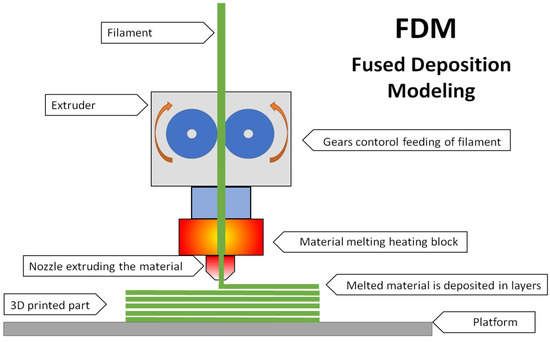
Figure 2. A diagram of the 3D printing process using the FDM technique.


This research is based on using a 3D printer as a laboratory tool to introduce various chemical substances, e.g., dyes, solvents, organic compounds, and organosilicon compounds, into a polymer matrix. Most studies on polymer modification rely on traditional techniques that involve adding additives during the liquid polymer state. These methods include extrusion, mixing, rolling, and kneading in mixers [16] or mixing the modifier with a polymer solution in a volatile solvent and the subsequent removal [8]. This article discusses methods that eliminate the need for costly and energy-consuming processing equipment. These methods can be utilized in any laboratory by users without access to specialized devices. The proposed method of introducing chemical substances into the polymer matrix consists of surface modification of the filament through immersing in a solution (see Figure 3).
The filament is passed through a reservoir containing a modifier (a liquid chemical substance or its solution) and then through a drying or excess substance removal system. During the next stage, the filament that has been coated with the modifier is fed directly to the 3D printer head. Once there, it is melted and extruded through a nozzle, forming a three-dimensional object layer by layer. This method enables the testing of a large number of substances with high efficiency and throughput for creating previously unknown functional materials that open up entirely new application possibilities. Currently, tens of millions of different chemical compounds are discovered worldwide, and the properties and potential uses/applications of most of them have not yet been explored. Most additives introduced into the polymer matrix serve functional purposes, such as improving product durability under different atmospheric conditions or enhancing antistatic properties, increasing the strength and usability, changing the thermal properties, and modifying the color, among others [17,18,19,20].
Coating a filament’s surface with a liquid modifier can occur either during printing (Figure 4(2.1,2.2)) or separately outside the printing process (Figure 4(2.3,2.4)). The L-FDM printing technique enables the use of one reservoir with a liquid modifier (Figure 4(2.1)) or multiple reservoirs with different chemical substances capable of dissolving in various solvents (Figure 4(2.2)). The filament modification presented in the diagrams in Figure 4(2.3,2.4) also involves passing the filament through a reservoir containing a modifier and a drying system, with the difference that, in the next stage, it does not go directly to the print head but is rewound onto the spool. This method also allows for multiple coatings of the filament surface with a chemical substance or the use of several different substances that dissolve in different solvents by winding the modified filament back onto the spool and passing it through the system again (Figure 4(2.3)) or by using multiple reservoirs with different modifiers (Figure 4(2.4)). This feature enables the filament to be utilized at a different location or time than the modification procedure itself.
In this article, we demonstrate the feasibility of incorporating particular substances into the polymer matrix during the printing process through the use of L-FDM technology. The obtained modifications were validated by a colorimetric analysis, optical microscopy, and scanning electron microscopy with energy-dispersive X-ray spectroscopy (SEM/EDS).


Download the full study as PDF here: Liquid for Fused Deposition Modeling Technique (L-FDM)—A Revolution in Application Chemicals to 3D Printing Technology: Color and Elements

or read it here

Przekop, R.E.; Gabriel, E.; Pakuła, D.; Sztorch, B. Liquid for Fused Deposition Modeling Technique (L-FDM)—A Revolution in Application Chemicals to 3D Printing Technology: Color and Elements. Appl. Sci.2023, 13, 7393.
https://doi.org/10.3390/app13137393 

Tags: excipientsformulation

Related Posts

Predicting disintegration time in fast-disintegrating tablets using machine learning a data-driven framework based on functional excipient representation
Disintegrant / Superdisintergrant

Predicting disintegration time in fast-disintegrating tablets using machine learning: a data-driven framework based on functional excipient representation

24. April 2026
Workflow of AI modeling.
Artificial Intelligence

Application of AI in Tablet Development: An Integrated Machine Learning Framework for Pre-Formulation Property Prediction

24. April 2026
Hydroxypropyl Methylcellulose Capsules Enhance Aerodynamic Performance of Carrier-Based Dry Powder Inhaler Formulations A Comprehensive Evaluation of Capsule Material Effects
Capsugel

Hydroxypropyl Methylcellulose Capsules Enhance Aerodynamic Performance of Carrier-Based Dry Powder Inhaler Formulations: A Comprehensive Evaluation of Capsule Material Effects

23. April 2026
Next Post
Design and Evaluation of Hydrophobic Ion Paired Insulin Loaded Self Micro-Emulsifying Drug Delivery System for Oral Delivery

Design and Evaluation of Hydrophobic Ion Paired Insulin Loaded Self Micro-Emulsifying Drug Delivery System for Oral Delivery

Cart

Shop Search

  • Search for excipients and samples
  • Product Inquiry
  • Newsletter Registration
  • Visit the Homepage

Top Pharma-Excipient Links

  • Pharmaceutical Excipients – Some Definition
  • Inactive ingredient search for approved drug products in the USA
  • Excipient Suppliers List
  • GRAS Substances (SCOGS) Database
  • DC Excipients List
  • Homepage

About | Privacy Policy | Cookie policy | Cookie Settings | Contact | Homepage
Copyright: PharmaExcipients AG

Welcome Back!

Login to your account below

Forgotten Password?

Retrieve your password

Please enter your username or email address to reset your password.

Log In
No Result
View All Result
  • Shop
  • News
    • Specials
      • Excipients for CBD
      • Excipients & 3D Printing
      • Infographics – The overview
      • GMP-certified excipient production sites
      • The Future of TiO2
      • Excipients in the COVID-19 Vaccines
      • BASF PVP-Iodine
      • RegXcellence™
      • BASF Parenteral Excipients
    • World Days – The overview
  • Excipient basics
    • Excipient Solutions for CBD
    • Inorganic Chemicals
      • Calcium Carbonate
      • Calcium Phosphates
      • Calcium Sulfate
      • Halites
      • Metallic Oxides
      • Silica
    • Organic Chemicals
      • Actual Sugars
      • Artificial Sweeteners
      • Carbohydrates
      • Cellulose
      • Cellulose Esters
      • Cellulose Ethers
      • CMC and Croscarmellose Sodium
      • Converted Starch
      • Dried Starch
      • Microcrystalline Cellulose
      • Modified Starch
      • Starch
      • Sugars
      • Sugar Alcohols
    • Petrochemicals
      • Acrylic Polymers
      • Glycols
      • Mineral Hydrocarbons
      • Mineral Oils
      • Mineral Waxes
      • Petrolatum
      • Polyethylene Glycol (PEG)
      • Povidones
      • Propylene Glycol
      • Other Petrochemical Excipients
    • Oleochemicals
      • Fatty Alcohols
      • Glycerin
      • Mineral Stearates
      • Pharmaceutical Oils
      • Other Oleochemical Excipients
    • Proteins
  • Applications
    • 3D Printing – Drug Carrier
      • 3D Printing
      • Binder
      • Coating
      • Colour / Color
      • Coating Systems and Additives
      • Controlled Release Excipient
      • DC excipient
      • Disintegrant / Superdisintergrant
      • Drug Carrier
    • Emulsifier – Glidant
      • Emulsifier
      • Excipient for Inhalation
      • Filler
      • Film former
      • Flavour / Flavor
      • Glidant
    • Lubricant – Preservative
      • Lubricant
      • Nanotechnology
      • Orally Dissolving Technology Excipient
      • Pellet
      • Plasticizer
      • Preservative
    • Solubilizer – Viscocity Agent
      • Solubilizer
      • Speciality Excipient
      • Surfactants
      • Suspension Agent
      • Sustained Release Agent
      • Sweeteners
      • Taste Masking
      • Topical Excipient
      • Viscocity Agent
  • Sources
    • Handbook of Pharmaceutical Excipients – 9th Edition
    • EINECS Numbers
    • Excipient DMF List
    • Excipient cGMP Certification Organisations
    • FDA Inactive Ingredient List
    • FDA GRAS Substances (SCOGS) Database
    • Excipient E-Numbers
    • Whitepapers / Publications
    • Contract Development|Contract Manufacturing
  • Suppliers
    • A-B
      • ADM
      • ARMOR PHARMA
      • Ceolus™ & Celphere™
      • Ashland
      • BASF
      • Beneo – galenIQ
      • Biogrund
      • Budenheim
    • C-G
      • Captisol
      • Croda
      • Cyclolab
      • DFE Pharma
      • DuPont Pharma Solutions
      • Evonik
      • Fuji Chemical Industries
      • Gattefossé
      • Gangwal Healthcare
    • I-O
      • ingredientpharm
      • IOI Oleochemical
      • JRS Pharma
      • Kerry
      • KLK Oleo Life Science
      • Lactalis Ingredients Pharma
      • Lipoid
      • Dr. Paul Lohmann
      • Lubrizol
      • Magnesia
      • MEGGLE Excipients
      • Nagase Viita – Pharmaceutical Ingredients
      • Nordic Bioproducts Group
    • P-Z
      • Pfanstiehl
      • pharm-a-spheres
      • Pharma Line
      • PMC Isochem
      • Roquette Pharma
      • Seppic
      • Shin-Etsu
      • Sigachi Group
      • Südzucker AG
      • VIKRAM THERMO
      • Zerion Pharma
      • ZoomLab® – Your Virtual Pharma Assistant
  • Inquiries
    • Product Inquiry
    • Tailored Tableting Excipients
      • Tailored Film Coating
  • Events
    • Overview Pharmaceutical Webinars
    • Videos CPhI Frankfurt 2025
    • CPhI China 2024
    • ExciPerience – The great excipient event!
  • All4Nutra

About | Privacy Policy | Cookie policy | Cookie Settings | Contact | Homepage
Copyright: PharmaExcipients AG