





Pharma Excipients
No Result
View All Result
  • Login
  • Shop
  • News
    • Specials
      • Excipients for CBD
      • Excipients & 3D Printing
      • Infographics – The overview
      • GMP-certified excipient production sites
      • The Future of TiO2
      • Excipients in the COVID-19 Vaccines
      • BASF PVP-Iodine
      • RegXcellence™
      • BASF Parenteral Excipients
    • World Days – The overview
  • Excipient basics
    • Excipient Solutions for CBD
    • Inorganic Chemicals
      • Calcium Carbonate
      • Calcium Phosphates
      • Calcium Sulfate
      • Halites
      • Metallic Oxides
      • Silica
    • Organic Chemicals
      • Actual Sugars
      • Artificial Sweeteners
      • Carbohydrates
      • Cellulose
      • Cellulose Esters
      • Cellulose Ethers
      • CMC and Croscarmellose Sodium
      • Converted Starch
      • Dried Starch
      • Microcrystalline Cellulose
      • Modified Starch
      • Starch
      • Sugars
      • Sugar Alcohols
    • Petrochemicals
      • Acrylic Polymers
      • Glycols
      • Mineral Hydrocarbons
      • Mineral Oils
      • Mineral Waxes
      • Petrolatum
      • Polyethylene Glycol (PEG)
      • Povidones
      • Propylene Glycol
      • Other Petrochemical Excipients
    • Oleochemicals
      • Fatty Alcohols
      • Glycerin
      • Mineral Stearates
      • Pharmaceutical Oils
      • Other Oleochemical Excipients
    • Proteins
  • Applications
    • 3D Printing – Drug Carrier
      • 3D Printing
      • Binder
      • Coating
      • Colour / Color
      • Coating Systems and Additives
      • Controlled Release Excipient
      • DC excipient
      • Disintegrant / Superdisintergrant
      • Drug Carrier
    • Emulsifier – Glidant
      • Emulsifier
      • Excipient for Inhalation
      • Filler
      • Film former
      • Flavour / Flavor
      • Glidant
    • Lubricant – Preservative
      • Lubricant
      • Nanotechnology
      • Orally Dissolving Technology Excipient
      • Pellet
      • Plasticizer
      • Preservative
    • Solubilizer – Viscocity Agent
      • Solubilizer
      • Speciality Excipient
      • Surfactants
      • Suspension Agent
      • Sustained Release Agent
      • Sweeteners
      • Taste Masking
      • Topical Excipient
      • Viscocity Agent
  • Sources
    • Handbook of Pharmaceutical Excipients – 9th Edition
    • EINECS Numbers
    • Excipient DMF List
    • Excipient cGMP Certification Organisations
    • FDA Inactive Ingredient List
    • FDA GRAS Substances (SCOGS) Database
    • Excipient E-Numbers
    • Whitepapers / Publications
    • Contract Development|Contract Manufacturing
  • Suppliers
    Excipient Suppliers List
    BIOGRUND Logo
    Evonik Logo
    LI logo violet
    logo roquette
    ADM
    Armor Pharma
    Asahi KASEI
    Ashland
    BASF

    Beneo

    Captisol

    Clariant Logo

    Clariant
    Croda
    DFE Pharma
    Excipio Chemicals
    Fuji Chemical
    Gattefossé

    Gangwal

    IamFluidics
    IamFluidics
    IOI Oleo
    Ingredient Pharm
    JRS Pharma
    Kerry Logo
    Kerry
    KLK Oleo
    KLK Oleo
    Lipoid
    Lubrizol Life Science Health

    Lubrizol Life Science Health
    MAGNESIA

    MAGNESIA
    MEGGLE Excipients & Technology
    MEGGLE
    Nagase Viita
    Nagase Viita
    Nordic Bioproducts
    Nordic Bioproducts
    Pfanstiehl
    Pfanstiehl
    pharm-a-spheres
    pharm-a-spheres
    PMC Isochem
    PMC Isochem
    Seppic
    Seppic
    ShinEtsu
    ShinEtsu
    Sigachi
    Sigachi
    SPI Pharma
    SPI Pharma
    Südzucker
    Südzucker
    Vikram Thermo
    Vikram Thermo
    Zerion Pharma
    Zerion Pharma
    • A-B
      • ADM
      • ARMOR PHARMA
      • Ceolus™ & Celphere™
      • Ashland
      • BASF
      • Beneo – galenIQ
      • Biogrund
      • Budenheim
    • C-G
      • Captisol
      • Croda
      • Cyclolab
      • DFE Pharma
      • DuPont Pharma Solutions
      • Evonik
      • Fuji Chemical Industries
      • Gattefossé
      • Gangwal Healthcare
    • I-O
      • ingredientpharm
      • IOI Oleochemical
      • JRS Pharma
      • Kerry
      • KLK Oleo Life Science
      • Lactalis Ingredients Pharma
      • Lipoid
      • Dr. Paul Lohmann
      • Lubrizol
      • Magnesia
      • MEGGLE Excipients
      • Nagase Viita – Pharmaceutical Ingredients
      • Nordic Bioproducts Group
    • P-Z
      • Pfanstiehl
      • pharm-a-spheres
      • Pharma Line
      • PMC Isochem
      • Roquette Pharma
      • Seppic
      • Shin-Etsu
      • Sigachi Group
      • Südzucker AG
      • VIKRAM THERMO
      • Zerion Pharma
      • ZoomLab® – Your Virtual Pharma Assistant
  • Inquiries
    • Product Inquiry
    • Tailored Tableting Excipients
      • Tailored Film Coating
  • Events
    • Overview Pharmaceutical Webinars
    • Videos CPhI Frankfurt 2025
    • CPhI China 2024
    • ExciPerience – The great excipient event!
  • All4Nutra

No products in the cart.

  • Shop
  • News
    • Specials
      • Excipients for CBD
      • Excipients & 3D Printing
      • Infographics – The overview
      • GMP-certified excipient production sites
      • The Future of TiO2
      • Excipients in the COVID-19 Vaccines
      • BASF PVP-Iodine
      • RegXcellence™
      • BASF Parenteral Excipients
    • World Days – The overview
  • Excipient basics
    • Excipient Solutions for CBD
    • Inorganic Chemicals
      • Calcium Carbonate
      • Calcium Phosphates
      • Calcium Sulfate
      • Halites
      • Metallic Oxides
      • Silica
    • Organic Chemicals
      • Actual Sugars
      • Artificial Sweeteners
      • Carbohydrates
      • Cellulose
      • Cellulose Esters
      • Cellulose Ethers
      • CMC and Croscarmellose Sodium
      • Converted Starch
      • Dried Starch
      • Microcrystalline Cellulose
      • Modified Starch
      • Starch
      • Sugars
      • Sugar Alcohols
    • Petrochemicals
      • Acrylic Polymers
      • Glycols
      • Mineral Hydrocarbons
      • Mineral Oils
      • Mineral Waxes
      • Petrolatum
      • Polyethylene Glycol (PEG)
      • Povidones
      • Propylene Glycol
      • Other Petrochemical Excipients
    • Oleochemicals
      • Fatty Alcohols
      • Glycerin
      • Mineral Stearates
      • Pharmaceutical Oils
      • Other Oleochemical Excipients
    • Proteins
  • Applications
    • 3D Printing – Drug Carrier
      • 3D Printing
      • Binder
      • Coating
      • Colour / Color
      • Coating Systems and Additives
      • Controlled Release Excipient
      • DC excipient
      • Disintegrant / Superdisintergrant
      • Drug Carrier
    • Emulsifier – Glidant
      • Emulsifier
      • Excipient for Inhalation
      • Filler
      • Film former
      • Flavour / Flavor
      • Glidant
    • Lubricant – Preservative
      • Lubricant
      • Nanotechnology
      • Orally Dissolving Technology Excipient
      • Pellet
      • Plasticizer
      • Preservative
    • Solubilizer – Viscocity Agent
      • Solubilizer
      • Speciality Excipient
      • Surfactants
      • Suspension Agent
      • Sustained Release Agent
      • Sweeteners
      • Taste Masking
      • Topical Excipient
      • Viscocity Agent
  • Sources
    • Handbook of Pharmaceutical Excipients – 9th Edition
    • EINECS Numbers
    • Excipient DMF List
    • Excipient cGMP Certification Organisations
    • FDA Inactive Ingredient List
    • FDA GRAS Substances (SCOGS) Database
    • Excipient E-Numbers
    • Whitepapers / Publications
    • Contract Development|Contract Manufacturing
  • Suppliers
    Excipient Suppliers List
    BIOGRUND Logo
    Evonik Logo
    LI logo violet
    logo roquette
    ADM
    Armor Pharma
    Asahi KASEI
    Ashland
    BASF
    Beneo
    Captisol
    Clariant Logo
    Clariant
    Croda
    DFE Pharma
    Excipio Chemicals
    Fuji Chemical
    Gattefossé
    Gangwal
    IamFluidics
    IamFluidics
    IOI Oleo
    Ingredient Pharm
    JRS Pharma
    Kerry Logo
    Kerry
    KLK Oleo
    KLK Oleo
    Lipoid
    Lubrizol Life Science Health
    Lubrizol Life Science Health
    MAGNESIA
    MAGNESIA
    MEGGLE Excipients & Technology
    MEGGLE
    Nagase Viita
    Nagase Viita
    Nordic Bioproducts
    Nordic Bioproducts
    Pfanstiehl
    Pfanstiehl
    pharm-a-spheres
    pharm-a-spheres
    PMC Isochem
    PMC Isochem
    Seppic
    Seppic
    ShinEtsu
    ShinEtsu
    Sigachi
    Sigachi
    SPI Pharma
    SPI Pharma
    Südzucker
    Südzucker
    Vikram Thermo
    Vikram Thermo
    Zerion Pharma
    Zerion Pharma
    • A-B
      • ADM
      • ARMOR PHARMA
      • Ceolus™ & Celphere™
      • Ashland
      • BASF
      • Beneo – galenIQ
      • Biogrund
      • Budenheim
    • C-G
      • Captisol
      • Croda
      • Cyclolab
      • DFE Pharma
      • DuPont Pharma Solutions
      • Evonik
      • Fuji Chemical Industries
      • Gattefossé
      • Gangwal Healthcare
    • I-O
      • ingredientpharm
      • IOI Oleochemical
      • JRS Pharma
      • Kerry
      • KLK Oleo Life Science
      • Lactalis Ingredients Pharma
      • Lipoid
      • Dr. Paul Lohmann
      • Lubrizol
      • Magnesia
      • MEGGLE Excipients
      • Nagase Viita – Pharmaceutical Ingredients
      • Nordic Bioproducts Group
    • P-Z
      • Pfanstiehl
      • pharm-a-spheres
      • Pharma Line
      • PMC Isochem
      • Roquette Pharma
      • Seppic
      • Shin-Etsu
      • Sigachi Group
      • Südzucker AG
      • VIKRAM THERMO
      • Zerion Pharma
      • ZoomLab® – Your Virtual Pharma Assistant
  • Inquiries
    • Product Inquiry
    • Tailored Tableting Excipients
      • Tailored Film Coating
  • Events
    • Overview Pharmaceutical Webinars
    • Videos CPhI Frankfurt 2025
    • CPhI China 2024
    • ExciPerience – The great excipient event!
  • All4Nutra
No Result
View All Result
Pharma Excipients
No Result
View All Result

Startseite » News » Nitrite testing in excipients – Industry best practices

Nitrite testing in excipients – Industry best practices

21. August 2025
Nitrite testing in excipients – Industry best practices

Nitrite testing in excipients – Industry best practices

Abstract

Nsingle bondNitrosamine risk assessment and control are essential components of pharmaceutical drug development and product evaluation. Nitrites present in excipients pose a risk to vulnerable amines that are present in APIs, API impurities or other process related amines, as they can be nitrosated to form N-nitrosamines. Detection and quantification of nitrite in excipients is an essential undertaking within the pharmaceutical industry to inform nitrosamine risk assessment and related risk mitigation strategies. An industry consortium and Lhasa Nitrites database was established to collaborate on this challenge, share knowledge, and reduce the testing burden. This article demonstrates the existing understanding of analytical techniques within this consortium for the quantification of nitrite in excipients incorporating IC with conductivity or UV detection, Griess derivatisation (with subsequent HPLC-UV or MS/MS detection or as PCD after IC), DAN derivatisation (with FL and MS detection) and cyclamate derivatisation (with GC-FID or GC–MS detection). We aim to highlight a variety of best practices as well as detailing their techniques principles, performance characteristics and sample preparation. Utilising the nitrite results in the database has highlighted a range in LOQs of nitrite that can be achieved, as well as knowledge of the advantages and disadvantages of using each analytical technique. This publication aims to facilitate the selection of an appropriate analytical method when considering nitrite in excipient determination.

Introduction

Since 2018, N-nitrosamines have been detected in some drug products at levels above their acceptable intakes, resulting in product recalls. Certain nitrosamines relevant for drug products are classified as probably or possibly carcinogenic to humans (groups 2A and 2B) by the International Agency for Research on Cancer (IARC). (World Health Organisation International Agency for Research on Cancer 2024) Consequently, this has led to the recall of several products, e.g. Sartan-based drug products (FDA 2024). Regulatory agencies and industry associations have issued guidance documents to help pharmaceutical companies to evaluate the risk of nitrosamine presence or formation in their products and implement mitigation strategies if a risk of nitrosamines has been confirmed (Dirat et al., 2025; EMA 2024; FDA 2024). One motivation for this paper is to provide a set of methods for nitrite testing especially as the pharmacopoeias currently do not have monographed methods. The most common mechanism for nitrosamine formation is the reaction of a vulnerable amine with a nitrosating agent (e.g. nitrite salts) under acidic conditions (Ashworth et al., 2020).

For example, active pharmaceutical ingredients (APIs) containing a vulnerable amine can react with nitrite from excipients during the drug product production or storage, producing nitrosamine drug substance related impurities (NDSRIs) (Cioc et al., 2023). This is particularly challenging because the formation of NDSRIs can occur with only trace levels of nitrite present. Therefore, minimising the contribution of nitrite from excipients (Wu et al., 2011) or any other component used in the drug product manufacturing process is an integral part of the control strategy to reduce the risk of nitrosamine formation since secondary or tertiary amine functional groups are prevalent in many crucial APIs (Nudelman et al., 2023). This prompted a collaboration with Lhasa Limited to start a nitrite data sharing initiative to further understand the extent of nitrite presence from pharmaceutical excipients and to reduce duplicated effort on this challenging topic where possible. The Lhasa Nitrites database was established to collect nitrite data for a broad range of excipients (Boetzel et al., 2023). The nitrite level often ranges from low ng/g to low µg/g levels, which necessitate the development and validation of a suite of analytical methods with high sensitivity for trace level analysis. The nitrite database includes validated nitrite data and related preferred analytical techniques and sample preparations. Over the past 4 years, the number of analytical techniques used across consortium members has increased along with the sensitivity and specificity requirements. The acceptable limits for Carcinogenic Potency Categorisation Approach (CPCA) class 1 and 2 nitrosamines have meant reaching low limit of quantifications (LOQs) for determining levels of nitrite in excipients is increasingly important for certain excipients.

A variety of analytical techniques can be used for the direct or indirect detection of nitrite (Moorcroft, 2001). These methods have both their advantages and limitations, and accurate quantitation of nitrite is highly dependent on the sample matrices. The most widely used techniques for nitrite determination in excipients are 1. Ion chromatography (IC) with conductivity detection, 2. IC with post column Griess derivatisation-ultraviolet (UV) followed by 3. High-performance liquid chromatography-UV (HPLC-UV) after Griess derivatisation. According to the Lhasa Nitrites database, 2025.1.0, (Lhasa Limited Nitrites Database 2025) 45 % of records utilised IC with conductivity or UV, 15 % of records utilised the Griess assay with or without liquid chromatography (LC), and 13 % of records utilised 2,3-diaminonaphthalene (DAN) derivatisation. Other techniques, such as cyclamate derivatisation with flame ionisation detector (FID) or mass spectrometry (MS) detection, LC with UV detection, IC post column Griess derivatisation with UV detection, and Griess derivatisation coupled with LC with tandem mass spectrometry (MS/MS) are utilised in 23 % of records.

Table 1 provides an overview of analytical methods that have been used to generate the data gathered in the Lhasa Nitrites database, 2025.1.0. The table provides insight on typical sensitivities (LOQs [µg/g], minimum, maximum and median values) and the prevalence of methods (number of records and percentage of records). A more detailed version of this table is provided in the supplementary material (Table S1). Very low minimum LOQ levels are mostly associated with highly soluble or liquid excipients and do not necessarily reflect the typical sensitivity of a method. Rather, median LOQ levels should be used to compare sensitivities between methods.

Developing a single platform method that will quantify nitrite in a variety of excipient types has its challenges due to different sample matrices. To generate high quality nitrite data with suitable sensitivity, it is important for excipient suppliers and users to work together to develop methods with sample preparation procedures that are adaptable to a variety of excipient types. This paper will provide an overview of the most frequently used analytical techniques described in the database, highlight the advantages and limitations of each technique, and recommend a common set of methods for routine use across the pharmaceutical industry. Though mentioned in Table 1, UV/visible (VIS) spectroscopy and HPLC-UV without derivatisation are not discussed in detail here. Both methods have been used early on to create data for the database but have today been replaced with better suited techniques.

Download the full article as PDF here: Nitrite testing in excipients – Industry best practices

or read it here

Sebastian Hickert, Kevin Näf, Jinjian Zheng, Tamas Balogh, Chris D. Smith, Juan Manuel Pallicer, Tom van Wijk, Roy Akkermans, Stéphanie Thonne, Giorgio Blom, James Sabatowski, Emma Pata, Grace Kocks, Gemma Packer, Nitrite testing in excipients – Industry best practices, European Journal of Pharmaceutical Sciences, Volume 213, 2025, 107236, ISSN 0928-0987, https://doi.org/10.1016/j.ejps.2025.107236.


Visit our free webinar:

The Right Choice:

Direct Compression Lactose in Drug Development & Sustainability 
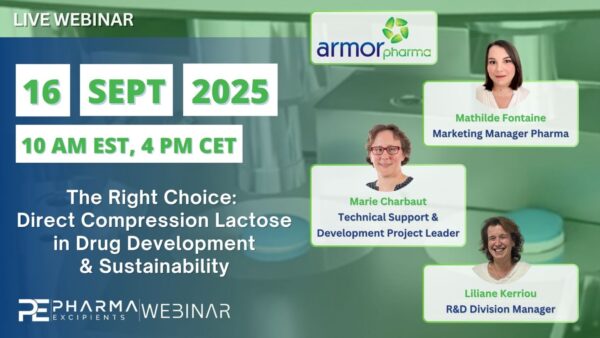
WEBINAR REcording HERE

The Right Choice Direct Compression Lactose in Drug Development & Sustainability
Tags: excipientsformulation

Related Posts

Workflow of AI modeling.
Artificial Intelligence

Application of AI in Tablet Development: An Integrated Machine Learning Framework for Pre-Formulation Property Prediction

24. April 2026
Hydroxypropyl Methylcellulose Capsules Enhance Aerodynamic Performance of Carrier-Based Dry Powder Inhaler Formulations A Comprehensive Evaluation of Capsule Material Effects
Capsugel

Hydroxypropyl Methylcellulose Capsules Enhance Aerodynamic Performance of Carrier-Based Dry Powder Inhaler Formulations: A Comprehensive Evaluation of Capsule Material Effects

23. April 2026
Patient-friendly dosage forms the potential of galenIQ™ in formulations of lozenges
Beneo

Patient-friendly dosage forms: the potential of galenIQ™ in formulations of lozenges

23. April 2026
Next Post
Mannosylated fisetin/carveol lipid nanocapsules

Mannosylated fisetin/carveol lipid nanocapsules: brain-targeted dual therapy for modulation of epileptogenesis and cognitive deficits

Cart

Shop Search

  • Search for excipients and samples
  • Product Inquiry
  • Newsletter Registration
  • Visit the Homepage

Top Pharma-Excipient Links

  • Pharmaceutical Excipients – Some Definition
  • Inactive ingredient search for approved drug products in the USA
  • Excipient Suppliers List
  • GRAS Substances (SCOGS) Database
  • DC Excipients List
  • Homepage

About | Privacy Policy | Cookie policy | Cookie Settings | Contact | Homepage
Copyright: PharmaExcipients AG

Welcome Back!

Login to your account below

Forgotten Password?

Retrieve your password

Please enter your username or email address to reset your password.

Log In
No Result
View All Result
  • Shop
  • News
    • Specials
      • Excipients for CBD
      • Excipients & 3D Printing
      • Infographics – The overview
      • GMP-certified excipient production sites
      • The Future of TiO2
      • Excipients in the COVID-19 Vaccines
      • BASF PVP-Iodine
      • RegXcellence™
      • BASF Parenteral Excipients
    • World Days – The overview
  • Excipient basics
    • Excipient Solutions for CBD
    • Inorganic Chemicals
      • Calcium Carbonate
      • Calcium Phosphates
      • Calcium Sulfate
      • Halites
      • Metallic Oxides
      • Silica
    • Organic Chemicals
      • Actual Sugars
      • Artificial Sweeteners
      • Carbohydrates
      • Cellulose
      • Cellulose Esters
      • Cellulose Ethers
      • CMC and Croscarmellose Sodium
      • Converted Starch
      • Dried Starch
      • Microcrystalline Cellulose
      • Modified Starch
      • Starch
      • Sugars
      • Sugar Alcohols
    • Petrochemicals
      • Acrylic Polymers
      • Glycols
      • Mineral Hydrocarbons
      • Mineral Oils
      • Mineral Waxes
      • Petrolatum
      • Polyethylene Glycol (PEG)
      • Povidones
      • Propylene Glycol
      • Other Petrochemical Excipients
    • Oleochemicals
      • Fatty Alcohols
      • Glycerin
      • Mineral Stearates
      • Pharmaceutical Oils
      • Other Oleochemical Excipients
    • Proteins
  • Applications
    • 3D Printing – Drug Carrier
      • 3D Printing
      • Binder
      • Coating
      • Colour / Color
      • Coating Systems and Additives
      • Controlled Release Excipient
      • DC excipient
      • Disintegrant / Superdisintergrant
      • Drug Carrier
    • Emulsifier – Glidant
      • Emulsifier
      • Excipient for Inhalation
      • Filler
      • Film former
      • Flavour / Flavor
      • Glidant
    • Lubricant – Preservative
      • Lubricant
      • Nanotechnology
      • Orally Dissolving Technology Excipient
      • Pellet
      • Plasticizer
      • Preservative
    • Solubilizer – Viscocity Agent
      • Solubilizer
      • Speciality Excipient
      • Surfactants
      • Suspension Agent
      • Sustained Release Agent
      • Sweeteners
      • Taste Masking
      • Topical Excipient
      • Viscocity Agent
  • Sources
    • Handbook of Pharmaceutical Excipients – 9th Edition
    • EINECS Numbers
    • Excipient DMF List
    • Excipient cGMP Certification Organisations
    • FDA Inactive Ingredient List
    • FDA GRAS Substances (SCOGS) Database
    • Excipient E-Numbers
    • Whitepapers / Publications
    • Contract Development|Contract Manufacturing
  • Suppliers
    • A-B
      • ADM
      • ARMOR PHARMA
      • Ceolus™ & Celphere™
      • Ashland
      • BASF
      • Beneo – galenIQ
      • Biogrund
      • Budenheim
    • C-G
      • Captisol
      • Croda
      • Cyclolab
      • DFE Pharma
      • DuPont Pharma Solutions
      • Evonik
      • Fuji Chemical Industries
      • Gattefossé
      • Gangwal Healthcare
    • I-O
      • ingredientpharm
      • IOI Oleochemical
      • JRS Pharma
      • Kerry
      • KLK Oleo Life Science
      • Lactalis Ingredients Pharma
      • Lipoid
      • Dr. Paul Lohmann
      • Lubrizol
      • Magnesia
      • MEGGLE Excipients
      • Nagase Viita – Pharmaceutical Ingredients
      • Nordic Bioproducts Group
    • P-Z
      • Pfanstiehl
      • pharm-a-spheres
      • Pharma Line
      • PMC Isochem
      • Roquette Pharma
      • Seppic
      • Shin-Etsu
      • Sigachi Group
      • Südzucker AG
      • VIKRAM THERMO
      • Zerion Pharma
      • ZoomLab® – Your Virtual Pharma Assistant
  • Inquiries
    • Product Inquiry
    • Tailored Tableting Excipients
      • Tailored Film Coating
  • Events
    • Overview Pharmaceutical Webinars
    • Videos CPhI Frankfurt 2025
    • CPhI China 2024
    • ExciPerience – The great excipient event!
  • All4Nutra

About | Privacy Policy | Cookie policy | Cookie Settings | Contact | Homepage
Copyright: PharmaExcipients AG

























