
- Suppliers






ADM 
Antares 
Armor Pharma 
Asahi KASEI 
Ashland 
BASF 
Beneo 
Captisol 
Clariant 
Croda 
DFE Pharma 
Dow 
Excipio Chemicals 
Fuji Chemical 
Gattefossé 
Gangwal 
Indovinya 
Ingredient Pharm 
IOI Oleo 
JRS Pharma 
KLK Oleo 
Lipoid 
Lubrizol Life Science Health 
MAGNESIA 
MEGGLE 
Mingtai Chemical 
Nagase Viita 
Nordic Bioproducts 
pharm-a-spheres 
PMC Isochem 
PQ 
Seppic 
ShinEtsu 
Sigachi 
SPI Pharma 
Südzucker 
Vikram Thermo 
Zerion Pharma  All4Nutra
- Suppliers
ADM Antares Armor Pharma Asahi KASEI Ashland BASF Beneo Captisol Clariant Croda DFE Pharma Dow Excipio Chemicals Fuji Chemical Gattefossé Gangwal Indovinya Ingredient Pharm IOI Oleo JRS Pharma KLK Oleo Lipoid Lubrizol Life Science Health MAGNESIA MEGGLE Mingtai Chemical Nagase Viita Nordic Bioproducts pharm-a-spheres PMC Isochem PQ Seppic ShinEtsu Sigachi SPI Pharma Südzucker Vikram Thermo Zerion Pharma - All4Nutra

3D polyurethane vaginal rings for the delivery of steroid hormones using material extrusion additive manufacturing
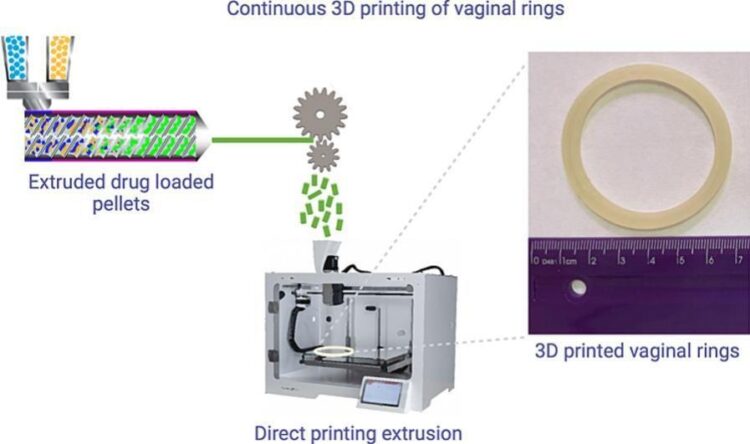
3D polyurethane vaginal rings for the delivery of steroid hormones using material extrusion additive manufacturing
Abstract
Three-dimensional printing has emerged as a novel technology to produce vaginal rings (VRs). However, the inherent high flexibility demanded by VRs poses a challenge when using filaments during the printing process. Here, we introduce a new approach for continuous 3D printing that eradicates the dependence on filaments and their printability for the fabrication of highly flexible VRs. Herein, Hot Melt Extrusion (HME) was used to create progesterone (PGR)-loaded thermoplastic polyurethane (TPU) pellets that were used as feedstock for 3D printing material extrusion of VRs. The TPU-based VRs presented excellent printability performance. Further physicochemical characterization indicated the presence of high amorphous PGR content while mechanical tests revealed that the VRs were consistently manufactured without significant deformation under prolonged compression and their performance was comparable to that of commercial VRs. The printed rings presented sustained release of clinically relevant quantities of progesterone over 28 days. Ex vivo studies showed that PGR permeated the porcine mucosa in a sustained manner for at least seven days. Finally, no cytotoxicity was observed in murine fibroblasts for the plain and progesterone-loaded pellets. This study demonstrates the potential of coupling HME and direct extrusion to produce 3D-printed VRs, aligning with the characteristics of traditional devices.
Introduction
During their lifetime, women go through unique health challenges regarding reproductive and sexual aspects of their lives, including the use of contraceptive methods, as well as the occurrence of postmenopausal symptoms, sexual dysfunction, and osteoporosis (Kim and Jarugula, 2020). Moreover, due to the individual anatomical characteristics of the female body, specific routes of drug administration have been developed for women. Among them, vaginal delivery is the most used, serving both local and systemic purposes in the administration of drugs (Neves et al., 2021). Therefore, women represent a unique population with specific features that require tailored health solutions.
The vaginal rings (VRs) are one of the most promising dosage forms for vaginal delivery. These flexible, torus-shaped polymer devices offer a mechanism for the controlled release of substances into the vagina over weeks to months (Sharifzadeh et al., 2020, Srikrishna and Cardozo, 2012). They are designed to be self-inserted into the vagina and can be placed without causing discomfort (Malcolm et al., 2012, Alexander et al., 2004). VR overcome several challenges related to traditional vaginal products, such as the limited retention time within the vagina and the occurrence of leakage/messiness (Major and McConville, 2017). In addition, the controlled and prolonged release of drugs provided by the device leads to a lower frequency of administration, thereby improving patient adherence to therapy (Tiboni et al., 2021). Currently, the VRs available on the market are mainly used to deliver hormones for contraception, hormone replacement therapy, and during in vitro fertilization (McBride et al., 2019).
VRs are commonly manufactured using biocompatible thermoplastic polymers and are available in four distinct designs: matrix (drug distributed within a polymer matrix), reservoir (the drug-polymer matrix is enveloped within a drug-free inert polymer), core/sheath (similar to reservoir but both inner core and outer sheath polymer matrices contain different drugs) and pod (polymer-coated drug cores are distributed through the ring) (Krovi et al., 2021, Malcolm et al., 2016). The commercially available VRs predominantly employ three types of non-biodegradable polymers: silicone elastomers, ethylene vinyl acetate copolymers (EVA), and thermoplastic polyurethanes (TPU) (Dedeloudi et al., 2022). The production of VRs typically involves elevated temperatures and relies primarily on injection moulding or hot melt extrusion (HME) processes (Tietz and Klein, 2019, Rafiei et al., 2021). During the injection moulding, a blend of polymer and drug is injected into a customized mould assembly, which has been preheated and attached to an injection moulding machine. In the extrusion, a temperature-controlled barrel accommodates the blend, which is propelled along the barrel by a screw mechanism. As the mixture reaches the end of the barrel, it is forced through a die with a defined geometry and size (Carson et al., 2021).
Recently, three-dimensional (3D) printing has been reported as a potential manufacturing technique for VRs (Tiboni et al., 2021, Fu et al., 2018, Eder et al., 2023, Koutsamanis et al., 2021, Arany et al., 2021, Chen et al., 2022, Janusziewicz et al., 2020, Junqueira et al., 2023). Also known as additive manufacturing, it encompasses a wide range of technologies where the object is produced through the deposition of sequential layers of material, guided by a 3D digital design. The primary advantage of employing 3D printing instead of conventional methods for fabricating VRs lies in its potential to customize the device’s attributes, encompassing size, shape, dose, and drug release, to align precisely with the unique requirements and preferences of each individual woman. The reported variations in the dimensions of the vagina among women indicate that adopting the traditional ‘one-size-fits-all’ approach for selecting the dimensions of a VR may not be optimal in terms of enhancing user comfort and acceptability and reducing the occurrence of involuntary expulsions (Boyd et al., 2020). Moreover, women’s responses to hormonal therapies can be influenced by various clinical and biological characteristics. Consequently, personalized optimization of doses, formulations, and delivery routes becomes essential to mitigate adverse effects and unfavorable outcomes effectively (Manson, 2013). Finally, our previous research demonstrated that women have multiple preferences towards the VR’s geometry, which can be tailored using 3D printing in order to meet the preferences of each woman and improve therapeutic adherence (Junqueira et al., 2023).
Currently, the existing studies on the application of 3D printing for designing and producing VRs predominantly concentrate on utilizing Fused Deposition Modeling (FDM) technology. To incorporate drugs into the VRs, hot melt extrusion (HME) can be employed to create drug-loaded filaments, which are used as the raw material in the printing process. Using this technique, Fu et al. (2018) produced custom-shaped VRs containing progesterone and a blend of polymers (PLA/PCL) (Fu et al., 2018); Tiboni et al. (2021) explored FDM to fabricate clotrimazole VRs using TPU (Tiboni et al., 2021) and Eder et al. (2023) investigated the personalization of vaginal inserts of EVA loaded with progesterone (Eder et al., 2023). Alternatively, drug loading can be achieved after the 3D printing of drug-free VRs. Koutsamanis et al. (2021) investigated the use of a novel polyester-based thermoplastic elastomer printed through FDM, and subsequently loaded with progesterone through solvent immersion (Koutsamanis et al., 2021). In addition, another approach involves manually filing the 3D-printed devices with a semisolid drug formulation, as demonstrated by Arany et al (2021) and Chen et al. (2022). The first one reported the manufacturing of TPU-based VRs filled with jellified metronidazole for the treatment of bacterial vaginosis (Arany et al., 2021), whilst the second designed and fabricated reservoir-type VR loaded after printing with hydroxypropyl methylcellulose gel containing multiple active drugs (Chen et al., 2022).
In this study, we employed a novel approach for fabricating VRs, using direct extrusion additive manufacturing, where granulated material (e.g., pellets or powder) is directly fed to the printhead to fabricate the desirable structure. The drug-loaded pellets were previously prepared using HME where a hydrophilic TPU was used to achieve the desired mechanical proprieties and a prolonged release of progesterone. Following an initial material characterization, we performed a comprehensive investigation of crucial parameters in the context of VRs i.e., mechanical tests, in vitro drug release, ex vivo permeation, and cytotoxicity.
Continue reading here
Materials
TPU Pathway™ (PYPT42DE35) was kindly donated by Lubrizol Advanced Materials, INC. (USA), and its properties are shown in Table S1 (supplementary material). Progesterone (PGR) was purchased from Tokyo Chemicals Industry UK Ltd. (UK). The solvents (HPLC grade) and salts (analytical grade) were obtained from Sigma Aldrich (USA). For cell culture studies, dimethyl sulfoxide (DMSO) was obtained from Synth (Brazil). The 3-(4,5-dimethylthiazol-2-yl)-2,5-diphenyltetrazolium bromide (MTT).
Laura Andrade Junqueira, Atabak Ghanizadeh Tabriz, Savvas Koltsakidis, Dimitrios Tzetzis, Francisco José Raposo, Dennis Douroumis, Marcos Antônio Fernandes Brandão, Nádia Rezende Barbosa Raposo, 3D polyurethane vaginal rings for the delivery of steroid hormones using material extrusion additive manufacturing, International Journal of Pharmaceutics, Volume 699, 2026, 127004, ISSN 0378-5173, https://doi.org/10.1016/j.ijpharm.2026.127004.
Read also our introduction article on 3D printing here:


