
- Suppliers






ADM 
Antares 
Armor Pharma 
Asahi KASEI 
Ashland 
BASF 
Beneo 
Captisol 
Clariant 
Croda 
DFE Pharma 
Dow 
Excipio Chemicals 
Fuji Chemical 
Gattefossé 
Gangwal 
Indovinya 
Ingredient Pharm 
IOI Oleo 
JRS Pharma 
KLK Oleo 
Lipoid 
Lubrizol Life Science Health 
MAGNESIA 
MEGGLE 
Mingtai Chemical 
Nagase Viita 
Nordic Bioproducts 
pharm-a-spheres 
PMC Isochem 
PQ 
Seppic 
ShinEtsu 
Sigachi 
SPI Pharma 
Südzucker 
Vikram Thermo 
Zerion Pharma  All4Nutra
- Suppliers
ADM Antares Armor Pharma Asahi KASEI Ashland BASF Beneo Captisol Clariant Croda DFE Pharma Dow Excipio Chemicals Fuji Chemical Gattefossé Gangwal Indovinya Ingredient Pharm IOI Oleo JRS Pharma KLK Oleo Lipoid Lubrizol Life Science Health MAGNESIA MEGGLE Mingtai Chemical Nagase Viita Nordic Bioproducts pharm-a-spheres PMC Isochem PQ Seppic ShinEtsu Sigachi SPI Pharma Südzucker Vikram Thermo Zerion Pharma - All4Nutra

A Thermoresponsive In Situ Salified Self-Nanoemulsifying Drug Delivery System of Olmesartan Medoxomil: Overcoming Leakage and Drug Trapping Limitations
A Thermoresponsive In Situ Salified Self-Nanoemulsifying Drug Delivery System of Olmesartan Medoxomil
Abstract
Background/Objectives: Solid self-nanoemulsifying drug delivery systems (SNEDDS) prepared by adsorption onto porous carriers are widely used to improve the oral delivery of poorly water-soluble drugs. However, this approach is limited by increased dosing volume and incomplete drug release. This study aims to develop a thermoresponsive in situ salified SNEDDS (T-IS-SNEDDS) that simultaneously prevents formulation leakage and overcomes the release limitations of conventional adsorption-based solidification.
Methods: Excipients were selected by solubility screening of oils and surfactants. Sodium and calcium carbonate were evaluated for in situ salt formation. Adsorption-based solid SNEDDS and thermoresponsive formulations containing poloxamer 188 with propylene glycol or polyethylene glycol 400 were prepared. Droplet size was measured after aqueous dilution. Solid-state characterization used scanning electron microscopy, Fourier transform infrared (FTIR) spectroscopy, differential scanning calorimetry, and powder X-ray diffraction. In vitro dissolution performance was evaluated against the raw drug and adsorption-based formulations.
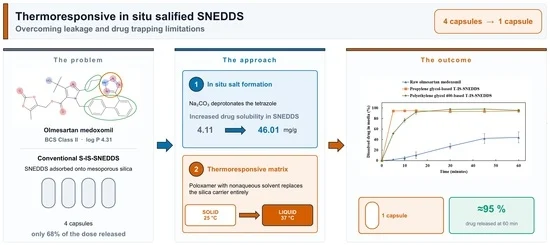
Results: Imwitor 308 and Tween 80 exhibited the highest solubilization capacities. Sodium carbonate (10 mg/g) markedly increased the solubility of olmesartan medoxomil from 4.11 ± 0.11 to 46.01 ± 1.92 mg/g. Although liquid in situ salified SNEDDS achieved rapid dissolution (94.2 ± 1.8% at 10 min), adsorption-based solidification required four capsules and yielded incomplete drug release (67.76 ± 3.18%). Both thermoresponsive formulations accommodated the therapeutic dose in a single capsule and released ≈95% of the drug within 60 min.
Conclusions: The combined in situ salified drug loading and thermoresponsive matrix strategy successfully enables single capsule administration while overcoming the incomplete release of adsorption-based solid SNEDDS.
Introduction
The oral route of administration is convenient and non-invasive. These features support its widespread use and lead to exceptional patient compliance with the dosage regimen. However, the low aqueous solubility of a large fraction of therapeutic molecules limits their dissolution and oral bioavailability [1]. To tackle this limitation, self-nanoemulsifying drug delivery systems (SNEDDS) have been widely used in the literature. They consist of anhydrous blends of oil, surfactant, and cosurfactant that disperse into nanoemulsion droplets upon contact with gastrointestinal fluids under mild agitation. This improves the solubilization and absorption of lipophilic drugs [2].
Regardless of these advantages, the liquid nature of SNEDDS limits its practical market application. This is attributed to leakage from the capsule shell and to incompatibility with the capsule during storage [3]. Consequently, several techniques have been used to convert liquid SNEDDS into solid dosage forms, including spray drying, lyophilization, hot-melt extrusion, and adsorption onto porous carriers [4]. Among these, the latter has attracted particular interest owing to its simple, solvent-free, and economical single-step preparation [5].
Nevertheless, the adsorption approach has two inherent limitations that hinder its transition to large-scale pharmaceutical production. First, the low density of the porous carrier and the carrier ratio required for complete solidification increase the total volume of the solid form. Therefore, formulation often requires multiple capsules to attain the therapeutic dose of the loaded drug [6,7]. Second, a portion of the loaded formulation becomes entrapped within the carrier pores and is released incompletely [8,9]. This reduces the dose available for absorption and negatively impacts the therapeutic response. Therefore, resolving these two limitations is crucial to achieve a desirable practical single-unit solid SNEDDS.
Attaining high drug loading within liquid SNEDDS positively reduces the total volume that must be solidified and overcomes the first limitation. This limitation is particularly pronounced for weakly acidic drugs that commonly show limited solubility in SNEDDS because they remain in their unionized form [10]. Salt formation is a well-established means of raising the solubility of ionizable drugs [11]. Alkalizing agents have been used for this purpose in various dosage forms [12,13]. In those systems, they increase drug solubility by raising the microenvironmental pH surrounding the drug.
Therefore, adding sodium carbonate to liquid SNEDDS promotes proton transfer from the ionizable drug to the base. It converts the drug into a more soluble salt and increases drug loading. A comparable gain in lipid vehicle loading was previously attained using preformed lipophilic salts [14]. Consequently, the resulting formulation is referred to as the liquid in situ salified SNEDDS (L-IS-SNEDDS).
However, incomplete release from the porous carrier requires an alternative solidification strategy to fully liberate the formulation in vivo. In this regard, a thermoresponsive matrix that remains solid during storage and reverts to a liquid at body temperature offers such a solution. This behavior can be achieved using a poloxamer dissolved in nonaqueous solvents such as propylene glycol and polyethylene glycol 400.
In aqueous media, poloxamers assemble into micelles that pack into ordered structures and solidify upon heating [15]. This behavior could be inverted when water is replaced by a nonaqueous solvent. Reversed micellar structures with a poly(ethylene oxide) core have been reported in ethanol-rich media, and their ordered domains melt upon heating [16]. Similarly, Pluronic F-127 dissolved in a glycol solvent remained fluid on heating and solidified only upon cooling. Hydrogen bonding, rather than the lyotropic packing that governs aqueous systems, was considered responsible for this behavior [17].
Consequently, combining poloxamer with a nonaqueous solvent allows tuning of this transition and yields thermoresponsive SNEDDS. Complete liquefaction of the matrix agents ensures complete dispersion of the SNEDDS formulation and the loaded agent, without the trapping risk seen in adsorption. Incorporating the salt-loaded formulation into this matrix yields the final optimized system: the thermoresponsive in situ salified SNEDDS (T-IS-SNEDDS).
Olmesartan medoxomil was selected as a model drug to evaluate this combined strategy. It is an orally administered angiotensin II receptor blocker used to treat high blood pressure. However, the lipophilic nature of olmesartan medoxomil results in an absolute oral bioavailability of only 26% [18]. Olmesartan medoxomil is highly lipophilic (log P = 4.31) and carries a weakly acidic tetrazole group (pKa ≈ 4.3) [19]. These properties make it suitable for both solubilization within a lipid vehicle and ionization-based loading enhancement.
Therefore, this study aimed to develop a formulation that combines thermoresponsive behavior with in situ salified drug loading. This could simultaneously overcome the drug-loading and incomplete-release limitations of conventional adsorption-based solid SNEDDS. The oil and surfactant were first selected from a solubility screening of olmesartan medoxomil. Next, two carbonate alkalizing agents (sodium carbonate and calcium carbonate) were used to assess their impact on drug loading. The proposed poloxamer 188 matrices, containing either propylene glycol or polyethylene glycol 400, were characterized by Fourier transform infrared spectroscopy, differential scanning calorimetry, and powder X-ray diffraction. The L-IS-SNEDDS was subsequently solidified using poloxamer-based systems with two types of nonaqueous solvents. For comparative assessment, a traditional solid form was prepared using Syloid as a solidifying agent. The self-emulsification behavior and droplet size of all formulations were assessed after aqueous dilution. The aforementioned formulations were evaluated for in vitro dissolution against the raw drug and the conventional Syloid adsorbate.
Download the full article as PDF here A Thermoresponsive In Situ Salified Self-Nanoemulsifying Drug Delivery System of Olmesartan Medoxomil
or continue reading here
Materials
Riyadh Pharma (Riyadh, Saudi Arabia) kindly donated olmesartan medoxomil. The oils used for solubility screening were obtained as follows: oleic acid from Avonchem Ltd. (Macclesfield, Cheshire, UK); Imwitor 308 and Miglyol 810N from Sasol Germany GmbH (Witten, Germany); Peceol and Maisine 35-1 from Gattefossé (Saint-Priest, France); Captex 355 from Abitec Corporation (Janesville, WI, USA); soybean oil from John L. Seaton & Co., Ltd. and Croda International Plc. (Hull, UK); and arachis oil from Winlab Laboratory Chemicals (Market Harborough, UK). The surfactants Tween 60 and Tween 85 were supplied by Merck-Schuchardt OHG (Hohenbrunn, Germany), Tween 20 by BDH (Poole, UK), and Tween 80 by Techno Pharmchem (Bahadurgarh, India). The PEG-hydrogenated castor oil surfactants HCO-60, HCO-30, and HCO-10 were obtained from Nikko Chemicals Co., Ltd. (Tokyo, Japan). The nonaqueous matrix solvents propylene glycol and polyethylene glycol 400 (Kollisolv PEG 400) were obtained from Winlab Laboratory Chemicals (Market Harborough, UK) and BASF (Ludwigshafen, Germany), respectively. Syloid was purchased from W. R. Grace & Co. (Columbia, MD, USA).
Sherif, A.Y.; Altamimi, M.A.; Elzayat, E.M. A Thermoresponsive In Situ Salified Self-Nanoemulsifying Drug Delivery System of Olmesartan Medoxomil: Overcoming Leakage and Drug Trapping Limitations. Pharmaceutics 2026, 18, 1195. https://doi.org/10.3390/pharmaceutics18091195
Are you looking for excipients in commercial quantities?


