- Suppliers






ADM 
Antares 
Armor Pharma 
Asahi KASEI 
Ashland 
BASF 
Beneo 
Captisol 
Clariant 
Croda 
DFE Pharma 
Dow 
Excipio Chemicals 
Fuji Chemical 
Gattefossé 
Gangwal 
Indovinya 
Ingredient Pharm 
IOI Oleo 
JRS Pharma 
KLK Oleo 
Lipoid 
Lubrizol Life Science Health 
MAGNESIA 
MEGGLE 
Mingtai Chemical 
Nagase Viita 
Nordic Bioproducts 
pharm-a-spheres 
PMC Isochem 
PQ 
Seppic 
ShinEtsu 
Sigachi 
SPI Pharma 
Südzucker 
Vikram Thermo 
Zerion Pharma  All4Nutra
- Suppliers
ADM Antares Armor Pharma Asahi KASEI Ashland BASF Beneo Captisol Clariant Croda DFE Pharma Dow Excipio Chemicals Fuji Chemical Gattefossé Gangwal Indovinya Ingredient Pharm IOI Oleo JRS Pharma KLK Oleo Lipoid Lubrizol Life Science Health MAGNESIA MEGGLE Mingtai Chemical Nagase Viita Nordic Bioproducts pharm-a-spheres PMC Isochem PQ Seppic ShinEtsu Sigachi SPI Pharma Südzucker Vikram Thermo Zerion Pharma - All4Nutra

Efficient DEM modelling of direct shear test with a representative volume element: Balancing fidelity and performance across boundary conditions, particle shape, and size distribution
Efficient DEM modelling of direct shear test with a representative volume element
Abstract
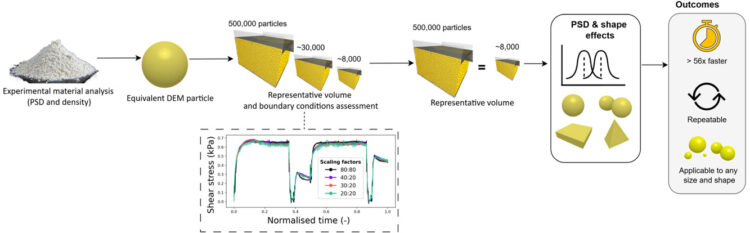
This study presents an efficient discrete element method (DEM) model for simulating a direct shear test and extracting yield locus parameters. A representative volume element (RVE) containing 20 particles per spatial direction (≈8000 particles) produced yield loci statistically equivalent to a baseline RVE (≈5×10⁵ particles), while reducing runtime by 25.9× versus the baseline and 56.8× versus the widest polydisperse case. Extracted metrics included major principal stress (σ1), unconfined yield strength (σc), flow function coefficient (ffc), angle of internal friction (ϕ), and effective angle of internal friction (ϕe). Particle size distribution (PSD) was evaluated using normal distributions with 15%–33% coefficient of variation and bimodal profiles, with and without cohesion. Within the RVE geometry and parameter space examined, PSD span and profile produced no measurable changes in macroscopic yield locus parameters.
Larger samples with increased PSD complexity did not improve yield locus fidelity here. Particle shape effects were stronger, friction angles increased as sphericity decreased and aspect ratio increased. Boundary conditions affected inferred strength, rigid confinement and high wall friction produced the highest ϕ. Mean coordination number (Z) varied modestly across PSD and shape cases, indicating that mean Z alone was insufficient to explain the shape-dependent macroscopic shear response differences. A practical workflow is proposed for selecting sample size, boundary conditions, shear protocol, and material descriptors. While not intended as a universally representative model, the workflow provides a reproducible, scalable basis for efficient direct shear test DEM calibration and future experimental validation.
Highlights
- A compact DEM shear model preserved yield locus fidelity with reduced runtime.
- Wide PSD span showed no clear effects on stress evolution or yield locus parameters.
- Particle shape drives friction mobilisation more strongly than PSD complexity.
- Periodic boundaries reduced wall-traction artefacts in DEM shear calibration.
- A practical RVE workflow supports efficient DEM calibration from shear cell data.
Introduction
Discrete Element Method (DEM) is a numerical method grounded in contact mechanics, which simulates the behaviour of granular materials by representing individual particles as discrete elements [1], [2]. DEM is a Lagrangian approach for modelling solids at the particle scale where the interaction forces between particles are described using contact mechanics laws that model a wide range of micromechanical phenomena. These interactions are evaluated iteratively based on Newton’s second law to describe particle motion [3], [4]. DEM is widely adopted where macroscopic response emerges from evolving contact networks and void structure. It directly tracks particle rearrangement and stress transmission during flow, shear and densification, enabling mechanistic interpretation that is difficult to obtain experimentally or to prescribe reliably in continuum models. This motivation has driven its use across geomechanics and industrial particle processing, including coupled DEM with finite element method (FEM) or computational fluid dynamics (CFD) simulations [4], [5], [6], [7], [8], [9], [10], [11], [12], [13], [14], [15], [16]. This demonstrates the potential of DEM to provide otherwise difficult to obtain insight into the mechanics of particulate solids under a wide range of flow regimes and stress states.
DEM must be calibrated to ensure that the chosen parameter set reproduces the target bulk response for the material and test configuration of interest. Because many DEM inputs are difficult to measure directly, they are typically determined indirectly by matching simulated outcomes to a suitable macroscopic mechanical response of the physical material under similar settings [14], [17], [18]. Many model parameters are also commonly assumed to simplify the process [17], [18], [19]. Calibration is usually done by combining a parameter optimisation approach with different characterisation experiments of the bulk, such as a rotating drum, compressibility studies, and shear cell test [13], [14], [18], [20]. However, the literature offers limited consensus on a transferable, standardised procedure for parameter identification, and calibration is often application-specific and depends on the stress state and flow regime in the system of interest. As a result, parameter sets are commonly effective values that reproduce selected bulk responses for a given test configuration rather than uniquely measured material properties [17]. Multiple complementary calibration responses in different flow and stress systems are often required to obtain robust, transferable parameters [13], [17], [18]. The calibration strategy should be selected to reflect the stress state and flow regime relevant to the application. In a highly frictional quasi-static flow regime, direct shear test is commonly used to characterise bulk flow strength, where the yield locus provides a macroscopic calibration target [21], [22], [23], [24].
DEM shear cell modelling is typically implemented using one of three configurations: (i) an explicit physical-geometry approach that reproduces the apparatus dimensions and kinematics [25]; (ii) an idealised unit-cell (representative volume) with rigid and/or periodic boundaries to emulate bulk behaviour at reduced computational cost [13], [18], [26]; and (iii) a hybrid approach in which key features of the physical geometry are retained while only a representative portion of the domain is simulated [27], [28]. The present work adopts a variation of the latter approach through modelling a representative volume element (RVE). Despite the usage of shear cell simulations in DEM material characterisation, published studies often provide limited methodological detail on how the apparatus is idealised, and which boundary and modelling choices materially affect the calibrated response. As a result, calibration workflows frequently rely on simplifications and acceleration strategies that may compromise fidelity, such as using monodisperse or idealised particle representations, or adjusting selected parameters to manage computational cost [13], [17]. Computational expense remains a practical bottleneck, and although general acceleration approaches such as coarse-graining or reduced material stiffness have been proposed [17], [29], [30], there is still no broadly accepted, shear-cell-specific methodology that balances efficiency with predictive accuracy.
This work proposes a computationally efficient, DEM model based on an RVE of a direct shear test model designed to reproduce the stress state and loading conditions of direct shear testing (shearing under controlled normal stress). By examining both system-level and material-specific properties, the study identifies key factors that minimise computational cost while maximising accuracy and efficiency for the proposed model. Particular emphasis is placed on defining optimal system configuration, representative sample selection through identifying an RVE [31], and critical material attributes necessary for reliably replicating direct shear test behaviour in silico. This study does not address material calibration directly; instead, it focuses on the modelling methodology. The objectives are to examine an RVE DEM shear test simulations, establish representative sampling strategies, assess the influence of parameters on reliability and performance, and propose a practical approach applicable across different materials.
Download the full article as PDF here Efficient DEM modelling of direct shear test with a representative volume element
or continue reading here
Anas Almudahka, Stefan Pantaleev, Mohammad Salehian, John Armstrong, Blair F. Johnston, Daniel Markl, Efficient DEM modelling of direct shear test with a representative volume element: Balancing fidelity and performance across boundary conditions, particle shape, and size distribution, Powder Technology, Volume 486, Part 1,2027, 123171,ISSN 0032-5910, https://doi.org/10.1016/j.powtec.2026.123171.
Don’t miss our new free webinar, registration & information here:
Developing Reliable Capsule-Based Dry Powder Inhalers

Related Posts