
- Suppliers






ADM 
Antares 
Armor Pharma 
Asahi KASEI 
Ashland 
BASF 
Beneo 
Captisol 
Clariant 
Croda 
DFE Pharma 
Dow 
Excipio Chemicals 
Fuji Chemical 
Gattefossé 
Gangwal 
Indovinya 
Ingredient Pharm 
IOI Oleo 
JRS Pharma 
KLK Oleo 
Lipoid 
Lubrizol Life Science Health 
MAGNESIA 
MEGGLE 
Mingtai Chemical 
Nagase Viita 
Nordic Bioproducts 
pharm-a-spheres 
PMC Isochem 
PQ 
Seppic 
ShinEtsu 
Sigachi 
SPI Pharma 
Südzucker 
Vikram Thermo 
Zerion Pharma  All4Nutra
- Suppliers
ADM Antares Armor Pharma Asahi KASEI Ashland BASF Beneo Captisol Clariant Croda DFE Pharma Dow Excipio Chemicals Fuji Chemical Gattefossé Gangwal Indovinya Ingredient Pharm IOI Oleo JRS Pharma KLK Oleo Lipoid Lubrizol Life Science Health MAGNESIA MEGGLE Mingtai Chemical Nagase Viita Nordic Bioproducts pharm-a-spheres PMC Isochem PQ Seppic ShinEtsu Sigachi SPI Pharma Südzucker Vikram Thermo Zerion Pharma - All4Nutra

Predicting API Solubility in Lipid Excipients: A Combined PC-SAFT and Experimental Approach for Enhanced Oral Delivery
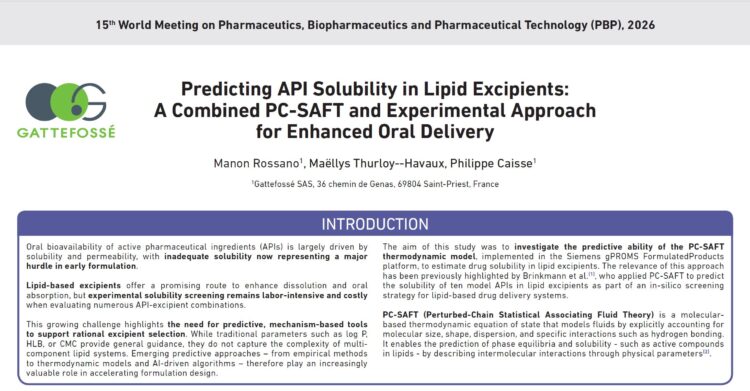
Predicting API Solubility in Lipid Excipients
This poster has been presented at the 15th World Meeting on Pharmaceutics, Biopharmaceutics and Pharmaceutical Technology, which took place in Prague, Czech Republic.
Predicting API Solubility in Lipid Excipients: A Combined PC-SAFT and Experimental Approach for Enhanced Oral Delivery
Introduction
Oral bioavailability of active pharmaceutical ingredients (APIs) is largely driven by solubility and permeability, with inadequate solubility now representing a major hurdle in early formulation.
Lipid-based excipients offer a promising route to enhance dissolution and oral absorption, but experimental solubility screening remains labor-intensive and costly when evaluating numerous API-excipient combinations.
This growing challenge highlights the need for predictive, mechanism-based tools to support rational excipient selection. While traditional parameters such as log P, HLB, or CMC provide general guidance, they do not capture the complexity of multicomponent lipid systems. Emerging predictive approaches – from empirical methods to thermodynamic models and AI-driven algorithms – therefore play an increasingly valuable role in accelerating formulation design.
The aim of this study was to investigate the predictive ability of the PC-SAFT thermodynamic model, implemented in the Siemens gPROMS FormulatedProducts platform, to estimate drug solubility in lipid excipients. The relevance of this approach has been previously highlighted by Brinkmann et al.[1], who applied PC-SAFT to predict the solubility of ten model APIs in lipid excipients as part of an in-silico screening strategy for lipid-based drug delivery systems.
PC-SAFT (Perturbed-Chain Statistical Associating Fluid Theory) is a molecularbased thermodynamic equation of state that models fluids by explicitly accounting for molecular size, shape, dispersion, and specific interactions such as hydrogen bonding. It enables the prediction of phase equilibria and solubility – such as active compounds in lipids – by describing intermolecular interactions through physical parameters[2].
Materials & Methods
The gPROMS FormulatedProducts suite from Siemens (gProperties module) was used to simulate solubility behavior of four APIs (fenofibrate, cinnarizine, ibuprofen, indomethacin) in four excipients from Gattefossé: Transcutol® (diethylene glycol monoethyl ether), Capryol® 90 (propylene glycol monocaprylate), Labrafac™ MC60 (glycerol monocaprylocaprate), Lauroglycol® FCC (propylene plycol monolaurate). For fenofibrate and cinnarizine, predictions were performed at three temperatures: 10, 25, and 37 °C. Predicted solubilities were then compared to experimental determinations. Statistical analysis was performed with Minitab 2024.

Experimental solubility tests were performed in selected lipid excipients by highperformance liquid chromatography coupled with UV detection (HPLC–UV). Saturated solutions were prepared, equilibrated at target temperatures, centrifuged, and analyzed quantitatively.

Results
From the PC-SAFT phase diagrams generated in gPROMS (fenofibrate in Capryol® 90 as an example in Figure 1), the mass fraction of the drug at equilibrium (kg/kg) was extracted and converted to mg/mL for each API & excipient, yielding the predicted solubility values for the four active compounds in four lipidic excipients at three temperatures. PC-SAFT-based predictions indicated that solubility increased with temperature across all excipients tested, which is also measured by experimental HPLC–UV measurements.
Statistical analysis demonstrated a very good correlation between PC-SAFT predictions and experimental solubility data for the whole set of data points, with a correlation coefficient r = 0.974 and p < 0.05 (Figure 2).


Nevertheless, certain limitations remain. Accurate PC-SAFT predictions require reliable pure-component parameters and binary interaction data, which may be unavailable in literature or complicated to generate for complex lipidic excipients. The model’s applicability to multi-component excipient blends remains to be fully validated.
Despite these challenges, the findings highlight the robustness of the approach for binary systems and encourage further extension towards more complex formulations.
Conclusion
In summary, the PC-SAFT thermodynamic model provides a predictive framework for screening drug solubility in lipid excipients. The correlation observed between in silico predictions and in vitro measurements for fenofibrate demonstrates its utility as a reliable screening tool.
While its application requires careful parameterization and is sometimes limited by data availability, PCSAFTsignificantly reduces experimental workload, API amount used and accelerates rational excipient selection in early drug development.
These results support the integration of advanced thermodynamic modelling into formulation workflows, enabling more efficient development of lipid-based drug delivery systems for poorly soluble APIs.
See the full poster on Predicting API Solubility in Lipid Excipients here
(click the picture to download the poster)

Source: Gattefossé SAS, Manon Rossano, Maëllys Thurloy-Havaux, Philippe Caisse, PBP poster: Predicting API Solubility in Lipid Excipients: A Combined PC-SAFT and Experimental Approach for Enhanced Oral Delivery
Enjoy also the other interesting posters of the PBP World Meeting 2026 here:

Excipients insights. Straight to your inbox. Subscribe now.


