





Pharma Excipients
No Result
View All Result
  • Login
  • Shop
  • News
    • Specials
      • Excipients for CBD
      • Excipients & 3D Printing
      • Infographics – The overview
      • GMP-certified excipient production sites
      • The Future of TiO2
      • Excipients in the COVID-19 Vaccines
      • BASF PVP-Iodine
      • RegXcellence™
      • BASF Parenteral Excipients
    • World Days – The overview
  • Excipient basics
    • Excipient Solutions for CBD
    • Inorganic Chemicals
      • Calcium Carbonate
      • Calcium Phosphates
      • Calcium Sulfate
      • Halites
      • Metallic Oxides
      • Silica
    • Organic Chemicals
      • Actual Sugars
      • Artificial Sweeteners
      • Carbohydrates
      • Cellulose
      • Cellulose Esters
      • Cellulose Ethers
      • CMC and Croscarmellose Sodium
      • Converted Starch
      • Dried Starch
      • Microcrystalline Cellulose
      • Modified Starch
      • Starch
      • Sugars
      • Sugar Alcohols
    • Petrochemicals
      • Acrylic Polymers
      • Glycols
      • Mineral Hydrocarbons
      • Mineral Oils
      • Mineral Waxes
      • Petrolatum
      • Polyethylene Glycol (PEG)
      • Povidones
      • Propylene Glycol
      • Other Petrochemical Excipients
    • Oleochemicals
      • Fatty Alcohols
      • Glycerin
      • Mineral Stearates
      • Pharmaceutical Oils
      • Other Oleochemical Excipients
    • Proteins
  • Applications
    • 3D Printing – Drug Carrier
      • 3D Printing
      • Binder
      • Coating
      • Colour / Color
      • Coating Systems and Additives
      • Controlled Release Excipient
      • DC excipient
      • Disintegrant / Superdisintergrant
      • Drug Carrier
    • Emulsifier – Glidant
      • Emulsifier
      • Excipient for Inhalation
      • Filler
      • Film former
      • Flavour / Flavor
      • Glidant
    • Lubricant – Preservative
      • Lubricant
      • Nanotechnology
      • Orally Dissolving Technology Excipient
      • Pellet
      • Plasticizer
      • Preservative
    • Solubilizer – Viscocity Agent
      • Solubilizer
      • Speciality Excipient
      • Surfactants
      • Suspension Agent
      • Sustained Release Agent
      • Sweeteners
      • Taste Masking
      • Topical Excipient
      • Viscocity Agent
  • Sources
    • EINECS Numbers
    • Excipient DMF List
    • Excipient cGMP Certification Organisations
    • FDA Inactive Ingredient List
    • FDA GRAS Substances (SCOGS) Database
    • Excipient E-Numbers
    • Whitepapers / Publications
    • Contract Development|Contract Manufacturing
  • Suppliers
    Excipient Suppliers List
    BIOGRUND Logo
    Evonik Logo
    LI logo violet
    logo roquette
    ADM
    Armor Pharma
    Asahi KASEI
    Ashland
    BASF

    Beneo

    Budenheim
    Captisol
    Croda
    DFE Pharma
    Excipio Chemicals
    Fuji Chemical
    Gattefossé

    Gangwal

    IOI Oleo
    Ingredient Pharm
    JRS Pharma
    Kerry Logo
    Kerry
    KLK Oleo
    KLK Oleo
    Lipoid
    Lubrizol Life Science Health

    Lubrizol Life Science Health
    MAGNESIA

    MAGNESIA
    MEGGLE Excipients & Technology
    MEGGLE
    Nagase Viita
    Nagase Viita
    Nordic Bioproducts
    Nordic Bioproducts
    Pfanstiehl
    Pfanstiehl
    pharm-a-spheres
    pharm-a-spheres
    PMC Isochem
    PMC Isochem
    Seppic
    Seppic
    ShinEtsu
    ShinEtsu
    Sigachi
    Sigachi
    SPI Pharma
    SPI Pharma
    Südzucker
    Südzucker
    Vikram Thermo
    Vikram Thermo
    Zerion Pharma
    Zerion Pharma
    • A-B
      • ADM
      • ARMOR PHARMA
      • Ceolus™ & Celphere™
      • Ashland
      • BASF
      • Beneo – galenIQ
      • Biogrund
      • Budenheim
    • C-G
      • Captisol
      • Croda
      • Cyclolab
      • DFE Pharma
      • DuPont Pharma Solutions
      • Evonik
      • Fuji Chemical Industries
      • Gattefossé
      • Gangwal Healthcare
    • I-O
      • ingredientpharm
      • IOI Oleochemical
      • JRS Pharma
      • Kerry
      • KLK Oleo Life Sciences
      • Lactalis Ingredients Pharma
      • Lipoid
      • Dr. Paul Lohmann
      • Lubrizol
      • Magnesia
      • MEGGLE Excipients
      • Nagase Viita – Pharmaceutical Ingredients
      • Nordic Bioproducts Group
    • P-Z
      • Pfanstiehl
      • pharm-a-spheres
      • Pharma Line
      • PMC Isochem
      • Roquette Pharma
      • Seppic
      • Shin-Etsu
      • Sigachi Group
      • Südzucker AG
      • VIKRAM THERMO
      • Zerion Pharma
      • ZoomLab® – Your Virtual Pharma Assistant
  • Inquiries
    • Product Inquiry
    • Tailored Tableting Excipients
      • Tailored Film Coating
  • Events
    • Overview Pharmaceutical Webinars
    • Videos CPhI Frankfurt 2025
    • CPhI China 2024
    • ExciPerience – The great excipient event!
  • More
    • Handbook of Pharmaceutical Excipients – 9th Edition
    • Jobs
      • Job Submission

No products in the cart.

  • Shop
  • News
    • Specials
      • Excipients for CBD
      • Excipients & 3D Printing
      • Infographics – The overview
      • GMP-certified excipient production sites
      • The Future of TiO2
      • Excipients in the COVID-19 Vaccines
      • BASF PVP-Iodine
      • RegXcellence™
      • BASF Parenteral Excipients
    • World Days – The overview
  • Excipient basics
    • Excipient Solutions for CBD
    • Inorganic Chemicals
      • Calcium Carbonate
      • Calcium Phosphates
      • Calcium Sulfate
      • Halites
      • Metallic Oxides
      • Silica
    • Organic Chemicals
      • Actual Sugars
      • Artificial Sweeteners
      • Carbohydrates
      • Cellulose
      • Cellulose Esters
      • Cellulose Ethers
      • CMC and Croscarmellose Sodium
      • Converted Starch
      • Dried Starch
      • Microcrystalline Cellulose
      • Modified Starch
      • Starch
      • Sugars
      • Sugar Alcohols
    • Petrochemicals
      • Acrylic Polymers
      • Glycols
      • Mineral Hydrocarbons
      • Mineral Oils
      • Mineral Waxes
      • Petrolatum
      • Polyethylene Glycol (PEG)
      • Povidones
      • Propylene Glycol
      • Other Petrochemical Excipients
    • Oleochemicals
      • Fatty Alcohols
      • Glycerin
      • Mineral Stearates
      • Pharmaceutical Oils
      • Other Oleochemical Excipients
    • Proteins
  • Applications
    • 3D Printing – Drug Carrier
      • 3D Printing
      • Binder
      • Coating
      • Colour / Color
      • Coating Systems and Additives
      • Controlled Release Excipient
      • DC excipient
      • Disintegrant / Superdisintergrant
      • Drug Carrier
    • Emulsifier – Glidant
      • Emulsifier
      • Excipient for Inhalation
      • Filler
      • Film former
      • Flavour / Flavor
      • Glidant
    • Lubricant – Preservative
      • Lubricant
      • Nanotechnology
      • Orally Dissolving Technology Excipient
      • Pellet
      • Plasticizer
      • Preservative
    • Solubilizer – Viscocity Agent
      • Solubilizer
      • Speciality Excipient
      • Surfactants
      • Suspension Agent
      • Sustained Release Agent
      • Sweeteners
      • Taste Masking
      • Topical Excipient
      • Viscocity Agent
  • Sources
    • EINECS Numbers
    • Excipient DMF List
    • Excipient cGMP Certification Organisations
    • FDA Inactive Ingredient List
    • FDA GRAS Substances (SCOGS) Database
    • Excipient E-Numbers
    • Whitepapers / Publications
    • Contract Development|Contract Manufacturing
  • Suppliers
    Excipient Suppliers List
    BIOGRUND Logo
    Evonik Logo
    LI logo violet
    logo roquette
    ADM
    Armor Pharma
    Asahi KASEI
    Ashland
    BASF
    Beneo
    Budenheim
    Captisol
    Croda
    DFE Pharma
    Excipio Chemicals
    Fuji Chemical
    Gattefossé
    Gangwal
    IOI Oleo
    Ingredient Pharm
    JRS Pharma
    Kerry Logo
    Kerry
    KLK Oleo
    KLK Oleo
    Lipoid
    Lubrizol Life Science Health
    Lubrizol Life Science Health
    MAGNESIA
    MAGNESIA
    MEGGLE Excipients & Technology
    MEGGLE
    Nagase Viita
    Nagase Viita
    Nordic Bioproducts
    Nordic Bioproducts
    Pfanstiehl
    Pfanstiehl
    pharm-a-spheres
    pharm-a-spheres
    PMC Isochem
    PMC Isochem
    Seppic
    Seppic
    ShinEtsu
    ShinEtsu
    Sigachi
    Sigachi
    SPI Pharma
    SPI Pharma
    Südzucker
    Südzucker
    Vikram Thermo
    Vikram Thermo
    Zerion Pharma
    Zerion Pharma
    • A-B
      • ADM
      • ARMOR PHARMA
      • Ceolus™ & Celphere™
      • Ashland
      • BASF
      • Beneo – galenIQ
      • Biogrund
      • Budenheim
    • C-G
      • Captisol
      • Croda
      • Cyclolab
      • DFE Pharma
      • DuPont Pharma Solutions
      • Evonik
      • Fuji Chemical Industries
      • Gattefossé
      • Gangwal Healthcare
    • I-O
      • ingredientpharm
      • IOI Oleochemical
      • JRS Pharma
      • Kerry
      • KLK Oleo Life Sciences
      • Lactalis Ingredients Pharma
      • Lipoid
      • Dr. Paul Lohmann
      • Lubrizol
      • Magnesia
      • MEGGLE Excipients
      • Nagase Viita – Pharmaceutical Ingredients
      • Nordic Bioproducts Group
    • P-Z
      • Pfanstiehl
      • pharm-a-spheres
      • Pharma Line
      • PMC Isochem
      • Roquette Pharma
      • Seppic
      • Shin-Etsu
      • Sigachi Group
      • Südzucker AG
      • VIKRAM THERMO
      • Zerion Pharma
      • ZoomLab® – Your Virtual Pharma Assistant
  • Inquiries
    • Product Inquiry
    • Tailored Tableting Excipients
      • Tailored Film Coating
  • Events
    • Overview Pharmaceutical Webinars
    • Videos CPhI Frankfurt 2025
    • CPhI China 2024
    • ExciPerience – The great excipient event!
  • More
    • Handbook of Pharmaceutical Excipients – 9th Edition
    • Jobs
      • Job Submission
No Result
View All Result
Pharma Excipients
No Result
View All Result

Startseite » News » Enhancing Drug Solubilization Using a Surface-modified Edible Biopolymer Through Hot Melt Extrusion: A Design Space Methodology

Enhancing Drug Solubilization Using a Surface-modified Edible Biopolymer Through Hot Melt Extrusion: A Design Space Methodology

28. August 2025
Enhancing Drug Solubilization Using a Surface-modified Edible Biopolymer Through Hot Melt Extrusion

Enhancing Drug Solubilization Using a Surface-modified Edible Biopolymer Through Hot Melt Extrusion

Abstract

This study investigates the use of an octenylsuccinate-modified dendrimer-like biopolymer (OS-DLB) as a carrier matrix in the formulation of biodendrimeric solid dispersions (BDSDs) using hot melt extrusion (HME). Ibuprofen (IBU) and griseofulvin (GSF) were selected as model compounds due to their poor aqueous solubility – one limited by its hydrophobicity and the other by its strong crystal lattice, respectively. This study demonstrates that the BDSD formulation can significantly enhance the dissolution rates of the model compounds through a parallel liquid phase equilibrium, while retaining their predominantly crystalline state. Across the 13 runs, IBU BDSDs showed a rapid initial dissolution with inter-batch variability converging by 60 minutes, whereas GSF BDSDs displayed wider divergence. IBU also underwent some loss of crystallinity due to its miscibility with PLX, a phenomenon not observed for GSF. Using a design space approach, which integrates experimental design, multivariate prediction models, and response surface modeling, the findings reveal that processing temperature, residence time, and screw speed are important factors affecting the dissolution and crystallinity of the BDSDs. The extent of their influence, however, varies depending on the crystal lattice energy and hydrophobicity of the model compounds. The HME design space for producing GSF BDSDs is less sensitive to processing variables than that for IBU BDSDs. For GSF, uniform dispersion of PLX throughout the BDSD and preservation of OS-DLB structure are key to improving dissolution. In contrast, limited molecular distribution of PLX is crucial to producing IBU BDSDs with high crystallinity.

Introduction

Extrusion has a rich history dating back to the 19th century.1 Modern hot melt extrusion (HME) only emerged in the early 1930s in the plastics industry where it was used to manufacture products such as pipes, sheets, and bags.2 Over the past four decades, HME has become a key technology in the pharmaceutical industry for preparing pharmaceutical solid dosage forms.3 It is one of the most researched areas in the pharmaceutical field, with a steady increase in the number of patents issued and journal articles published since the early 1980s (Figure 1). Today, there is a wide array of marketed pharmaceutical dosage forms using HME, ranging from ophthalmic inserts and contraceptive implants to oral multiparticulates and tablets, demonstrating the versatility, feasibility, and scalability of HME as a processing technology.3 HME offers numerous advantages over traditional pharmaceutical processing techniques, including short processing (residence) time, intimate mixing, highly controllable processing conditions, and excellent process efficiency.4 Furthermore, HME is an environmentally-friendly, solvent-free continuous process that can be scaled to manufacture industrially relevant quantities using quality by design (QbD) principles.5

The prevalent use of high-throughput and combinatorial screening tools has led to a significant portion of new drug candidates exhibiting limited aqueous solubility, and thereby low oral bioavailability. In recent years, HME has been firmly established as a robust method for producing amorphous solid dispersions (ASDs) to improve the dissolution rates and bioavailability of these poorly-water soluble drugs.6, 7, 8 In an “ideal” ASD system, the crystalline lattice of the drug is disrupted, and the free molecules are molecularly dispersed within an amorphous polymer chain network. When exposed to an aqueous medium, the drug in the ASD presents itself in solution form, i.e. solutes, and the energy typically required to break up the crystalline lattice of the drug is no longer a limitation to the solvation of the drug in aqueous conditions. This results in an increase in the apparent solubility of the drug, leading to enhanced dissolution rates and improved oral bioavailability. However, ASDs often present several challenges that diminish their viability as commercial products. Processing temperatures typically higher than the melting temperature of the drug are used to ensure complete disruption of the crystal lattice structure of the drug, which presents a significant limitation, especially for thermolabile drugs. Furthermore, depending on the solubility of the drug in the polymeric carrier and its crystallization kinetics, the drug may partially or completely recrystallize during aging, adversely impacting the physicochemical properties of the drug product. When exposed to a limited volume of aqueous medium, which is typically the case in vivo, a supersaturated solution will be formed. This inevitably leads to precipitation, causing the system to lose the original advantages of an amorphous molecular dispersion. Despite their touted benefits, ASDs are not always practical due to these limitations.

To address these limitations, this study builds on previous research9 and investigates how non-amorphous biodendrimeric solid dispersions (BDSDs) prepared by HME can increase the apparent solubility and enhance the dissolution rate of poorly water-soluble drugs, while retaining a predominantly crystalline state of the compound. Solubilization strategies that do not involve obliterating the crystal lattice structure of drugs present an attractive alternative for enhancing dissolution rates and oral bioavailability. However, the success of such strategies requires a careful combination of functional excipients, such as carrier matrices and processing aids, along with optimized processing conditions, to produce non-amorphous systems that are just as effective, if not more so, than their amorphous counterparts. Such systems prepared by HME have been widely reported. Thommes et al. produced “solid crystal suspensions” of griseofulvin, phenytoin, and spironolactone, where drug particles were dispersed at the particulate level in crystalline mannitol by HME at processing temperatures above the melting point of mannitol but below that of the drugs.10 The result was a thermodynamically stable dispersion with rapid dissolution rate. Boksa et al. and several research groups have studied extensively the concurrent production and formulation of cocrystals via HME, where the cocrystals were physically embedded in a functional polymer matrix, which allowed for fine-tuning of the apparent solubility and dissolution rate.11, 12, 13 These examples demonstrate the potential of producing thermodynamically stable, non-amorphous dispersion systems via HME to increase the dissolution rate of poorly soluble drugs while avoiding the known issues related to ASDs.

Specifically, this research aims to establish a set of HME processing parameters and understand the factors influencing the performance of the BDSD through a design space approach, a key component of the QbD paradigm in drug development. Unlike industrial product development contexts where critical quality attributes (CQAs) are defined, the design space established here is not intended to meet CQA specifications or identify the edge of failure for process parameters and material attributes. Instead, by integrating experimental design, multivariate prediction models, and response surface modeling, this study focuses on achieving a thorough understanding of the factors affecting the dissolution and crystallinity of BDSD formulations.

The BDSD formulation consists of an active pharmaceutical ingredient (API), an octenylsuccinate-modified dendrimer-like biopolymer (OS-DLB) as a carrier matrix, and poloxamer 338 (PLX) as a processing aid. Griseofulvin (GSF) and ibuprofen (IBU) were selected as model APIs due to their low aqueous solubility. The solubilization of a crystalline organic compound in an aqueous medium entails two distinct steps. The first step is breaking the crystal lattice into individual molecules, and the second step is solvating these free molecules with water molecules. The first step depends on the crystal lattice energy of the compound, which can be reflected by its melting temperature. Generally, compounds with a higher melting temperature indicate greater crystal lattice energy, consequently leading to lower aqueous solubility.14 GSF is an example of such a compound, with a high melting temperature (217°C) and a low aqueous solubility (9.86 mg/L).9 The second step of solubilization depends on the energy barrier to mix the solute molecules with water molecules. Highly hydrophobic compounds exhibit low aqueous solubility due to the presence of a significant energy barrier to solvation. IBU, despite having a relatively low melting temperature (75°C), has an aqueous solubility of only 55 mg/L due to its high hydrophobicity.9

The dendrimer-like biopolymer (DLB) material used in this study is phytoglycogen, a naturally occurring polysaccharide found in plant mutants such as those of sweet corn, sorghum, and algae. Phytoglycogen exists as spherical monodisperse particles, typically ranging between 30 nm and 100 nm.15 The role of DLB, specifically one that is covalently modified with octenylsuccinate (OS) groups, is to enhance the apparent solubility and dissolution of the API through a parallel liquid phase equilibrium.16, 17 The hydrophobic C8 chains of the OS groups create a favorable nonpolar microenvironment that imparts solubility-enhancing functionality to DLB, which by itself have negligible solubilizing ability. Unlike common polymers used in HME, phytoglycogen nanoparticles do not facilitate the processability of HME. To enable a “warm” melt extrusion process that prevents the caramelization of phytoglycogen when subjected to high heat and to avoid the melting of the API in order to preserve its crystallinity, a processing aid is required. While several processing aids could serve this purpose, the choice in this study is limited. The processing aid should not exert a solubilizing effect on the model APIs on its own to minimize potential confounding effects, thereby allowing a clearer understanding of the solubilizing properties of OS-DLB.9 Considering these factors, PLX was chosen as the processing aid.

Read more here

Materials

GSF was obtained from Hawkins (Minneapolis, MN) and IBU from BASF (Bishop, TX). Both APIs were used as received. PLX was obtained from BASF (North Mount Olive, NJ), and was gently ground with a mortar and pestle and screened through a US 100 mesh sieve (aperture size 150 μm) before use. OS-DLB was prepared by Professor Yuan Yao’s laboratory as described in previous studies. All solvents were of high-performance liquid chromatography (HPLC) grade and were obtained from Fisher Chemical.

Hwee Jing Ong, Fernando Alvarez-Nunez, Rodolfo Pinal, Enhancing Drug Solubilization Using a Surface-modified Edible Biopolymer Through Hot Melt Extrusion: A Design Space Methodology, Journal of Pharmaceutical Sciences, 2025, 103956, ISSN 0022-3549, https://doi.org/10.1016/j.xphs.2025.103956.


Visit our free webinar:

The Right Choice:

Direct Compression Lactose in Drug Development & Sustainability 
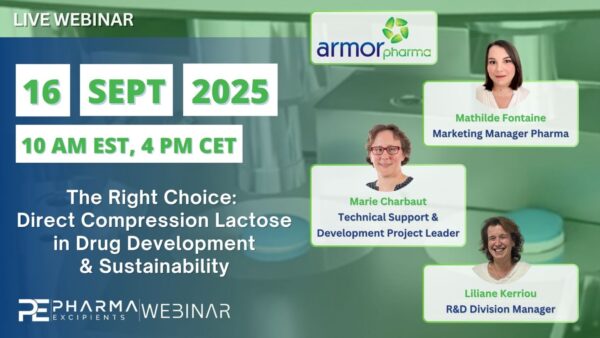
WEBINAR REcording HERE

The Right Choice Direct Compression Lactose in Drug Development & Sustainability
Tags: excipientsformulation

Related Posts

Design and characterization of propofol lipid nanocapsules
BASF

Design and characterization of propofol lipid nanocapsules: proof of concept for hospital preparation

14. February 2026
Contemporary Techniques and Prospects in Pharmaceutical Tablet Surface Analysis
Cellulose

Contemporary Techniques and Prospects in Pharmaceutical Tablet Surface Analysis

13. February 2026
Curcumin amorphous solid dispersions formed by Eudragit EPO and hydroxypropyl methylcellulose E50 achieve superior analgesic effect
Ashland

Curcumin amorphous solid dispersions formed by Eudragit EPO and hydroxypropyl methylcellulose E50 achieve superior analgesic effect

13. February 2026
Next Post
In vitro skin permeation of mitragynine

In vitro skin permeation of mitragynine: Optimisation of antioxidants for enhanced drug stability and formulation performance

Cart

Shop Search

  • Search for excipients and samples
  • Product Inquiry
  • Newsletter Registration
  • Visit the Homepage

Top Pharma-Excipient Links

  • Pharmaceutical Excipients – Some Definition
  • Inactive ingredient search for approved drug products in the USA
  • Excipient Suppliers List
  • GRAS Substances (SCOGS) Database
  • DC Excipients List
  • Homepage

About | Privacy Policy | Cookie policy | Cookie Settings | Contact | Homepage
Copyright: PharmaExcipients AG

Welcome Back!

Login to your account below

Forgotten Password?

Retrieve your password

Please enter your username or email address to reset your password.

Log In
No Result
View All Result
  • Shop
  • News
    • Specials
      • Excipients for CBD
      • Excipients & 3D Printing
      • Infographics – The overview
      • GMP-certified excipient production sites
      • The Future of TiO2
      • Excipients in the COVID-19 Vaccines
      • BASF PVP-Iodine
      • RegXcellence™
      • BASF Parenteral Excipients
    • World Days – The overview
  • Excipient basics
    • Excipient Solutions for CBD
    • Inorganic Chemicals
      • Calcium Carbonate
      • Calcium Phosphates
      • Calcium Sulfate
      • Halites
      • Metallic Oxides
      • Silica
    • Organic Chemicals
      • Actual Sugars
      • Artificial Sweeteners
      • Carbohydrates
      • Cellulose
      • Cellulose Esters
      • Cellulose Ethers
      • CMC and Croscarmellose Sodium
      • Converted Starch
      • Dried Starch
      • Microcrystalline Cellulose
      • Modified Starch
      • Starch
      • Sugars
      • Sugar Alcohols
    • Petrochemicals
      • Acrylic Polymers
      • Glycols
      • Mineral Hydrocarbons
      • Mineral Oils
      • Mineral Waxes
      • Petrolatum
      • Polyethylene Glycol (PEG)
      • Povidones
      • Propylene Glycol
      • Other Petrochemical Excipients
    • Oleochemicals
      • Fatty Alcohols
      • Glycerin
      • Mineral Stearates
      • Pharmaceutical Oils
      • Other Oleochemical Excipients
    • Proteins
  • Applications
    • 3D Printing – Drug Carrier
      • 3D Printing
      • Binder
      • Coating
      • Colour / Color
      • Coating Systems and Additives
      • Controlled Release Excipient
      • DC excipient
      • Disintegrant / Superdisintergrant
      • Drug Carrier
    • Emulsifier – Glidant
      • Emulsifier
      • Excipient for Inhalation
      • Filler
      • Film former
      • Flavour / Flavor
      • Glidant
    • Lubricant – Preservative
      • Lubricant
      • Nanotechnology
      • Orally Dissolving Technology Excipient
      • Pellet
      • Plasticizer
      • Preservative
    • Solubilizer – Viscocity Agent
      • Solubilizer
      • Speciality Excipient
      • Surfactants
      • Suspension Agent
      • Sustained Release Agent
      • Sweeteners
      • Taste Masking
      • Topical Excipient
      • Viscocity Agent
  • Sources
    • EINECS Numbers
    • Excipient DMF List
    • Excipient cGMP Certification Organisations
    • FDA Inactive Ingredient List
    • FDA GRAS Substances (SCOGS) Database
    • Excipient E-Numbers
    • Whitepapers / Publications
    • Contract Development|Contract Manufacturing
  • Suppliers
    • A-B
      • ADM
      • ARMOR PHARMA
      • Ceolus™ & Celphere™
      • Ashland
      • BASF
      • Beneo – galenIQ
      • Biogrund
      • Budenheim
    • C-G
      • Captisol
      • Croda
      • Cyclolab
      • DFE Pharma
      • DuPont Pharma Solutions
      • Evonik
      • Fuji Chemical Industries
      • Gattefossé
      • Gangwal Healthcare
    • I-O
      • ingredientpharm
      • IOI Oleochemical
      • JRS Pharma
      • Kerry
      • KLK Oleo Life Sciences
      • Lactalis Ingredients Pharma
      • Lipoid
      • Dr. Paul Lohmann
      • Lubrizol
      • Magnesia
      • MEGGLE Excipients
      • Nagase Viita – Pharmaceutical Ingredients
      • Nordic Bioproducts Group
    • P-Z
      • Pfanstiehl
      • pharm-a-spheres
      • Pharma Line
      • PMC Isochem
      • Roquette Pharma
      • Seppic
      • Shin-Etsu
      • Sigachi Group
      • Südzucker AG
      • VIKRAM THERMO
      • Zerion Pharma
      • ZoomLab® – Your Virtual Pharma Assistant
  • Inquiries
    • Product Inquiry
    • Tailored Tableting Excipients
      • Tailored Film Coating
  • Events
    • Overview Pharmaceutical Webinars
    • Videos CPhI Frankfurt 2025
    • CPhI China 2024
    • ExciPerience – The great excipient event!
  • More
    • Handbook of Pharmaceutical Excipients – 9th Edition
    • Jobs
      • Job Submission

About | Privacy Policy | Cookie policy | Cookie Settings | Contact | Homepage
Copyright: PharmaExcipients AG


























