- Suppliers



ADM 
Antares 
Armor Pharma 
Asahi KASEI 
Ashland 
BASF 
Beneo 
Captisol 
Clariant 
Croda 
DFE Pharma 
Dow 
Excipio Chemicals 
Fuji Chemical 
Gattefossé 
Gangwal 
Indovinya 
Ingredient Pharm 
IOI Oleo 
JRS Pharma 
KLK Oleo 
Lipoid 
Lubrizol Life Science Health 
MAGNESIA 
MEGGLE 
Mingtai Chemical 
Nagase Viita 
Nordic Bioproducts 
pharm-a-spheres 
PMC Isochem 
PQ 
Seppic 
ShinEtsu 
Sigachi 
SPI Pharma 
Südzucker 
Vikram Thermo 
Zerion Pharma  All4Nutra
- Suppliers
ADM Antares Armor Pharma Asahi KASEI Ashland BASF Beneo Captisol Clariant Croda DFE Pharma Dow Excipio Chemicals Fuji Chemical Gattefossé Gangwal Indovinya Ingredient Pharm IOI Oleo JRS Pharma KLK Oleo Lipoid Lubrizol Life Science Health MAGNESIA MEGGLE Mingtai Chemical Nagase Viita Nordic Bioproducts pharm-a-spheres PMC Isochem PQ Seppic ShinEtsu Sigachi SPI Pharma Südzucker Vikram Thermo Zerion Pharma - All4Nutra

Evaluation of olanzapine–excipient compatibility for the development of nanostructured lipid carriers: a preformulation study with lipids and surfactants

Evaluation of olanzapine–excipient compatibility for the development of nanostructured lipid carriers
Abstract
Drug-excipient interaction studies are fundamental for the efficient development of new formulations. These interactions directly influence drug stability, loading capacity, controlled release, and bioavailability, which are essential aspects to optimize therapeutic efficacy and minimize possible adverse effects. This research aimed to investigate the physicochemical compatibility of OLZ with lipid excipients intended for NLC formulation. Binary mixtures (1:1, w/w) of OLZ with a range of solid, liquid lipids and surfactants were examined using thermogravimetry (TG/DTG) and differential thermal analysis (DTA), and Fourier-transform infrared spectroscopy (FTIR). Isothermal stress tests were conducted at 60 ± 2 °C for a period of up to 30 days, and the OLZ content was measured using a validated HPLC method. The thermal and spectral analyses indicated interactions between OLZ and excipients such as oleic acid, Capmul®, Captex®, and Span® 60, as demonstrated by shifts or suppression of characteristic OLZ peaks. The degradation observed under stress conditions confirmed limited stability with stearic acid, lauric acid, palmitic acid, glyceryl monostearate, oleic acid, Capmul® and Span®60 and 80, with OLZ content reduced to 55.6–70.6% after 30 days in the most affected mixtures, compared to 100.0 ± 2.9% for pure OLZ. Overall, these findings emphasize the significance of excipient selection to guarantee stability and compatibility in the formulation of OLZ-loaded NLC systems.
Introduction
Olanzapine (OLZ) is an atypical antipsychotic widely employed in the treatment of schizophrenia and bipolar affective disorders. Despite its clinical efficacy, OLZ exhibits low aqueous solubility and is subject to extensive first-pass hepatic metabolism, resulting in an oral bioavailability of approximately 60–65%. This metabolic profile, rather than poor absorption alone, is the primary factor limiting its pharmacokinetic performance and contributes to inter-individual variability in plasma concentrations, which may compromise treatment adherence [1, 2].
In this context, the development of modified release systems represents a promising approach to optimize the pharmacokinetics behavior and therapeutic performance of olanzapine. Among the advanced drug delivery platforms, nanostructured lipid carriers (NLC) have attracted increasing attention owing to their capacity to efficiently encapsulate lipophilic drugs, confer protection against degradation, enable controlled release, and improve oral bioavailability [3, 4]. Among other applications, NLC have also been explored as platforms for site-specific drug targeting, including brain delivery strategies [5].
The development of NLC requires prior pre-formulation studies to ensure compatibility between the drug and excipients, as well as the technological viability of the system. While excipients are pharmacologically inactive, they may interact physically or chemically with each other or with the active pharmaceutical ingredient, potentially affecting its chemical nature, stability, bioavailability, and, ultimately, its efficacy [6,7,8,9,10]. In addition, OLZ has the ability to crystallize [11] into various solid forms, each potentially displaying distinct stability characteristics, it remains essential to explore its compatibility with excipients that are frequently utilized in the production of NLC.
Several studies have emphasized the importance of evaluating the compatibility between drugs and excipients in the development of nanostructured systems. Lipids such as stearic acid, oleic acid, Compritol® and Miglyol® and surfactants such as Tween® 80 were evaluated in compatibility studies with the aim of detecting possible interactions between olanzapine and the components of the formulation [6, 12, 13]. Studies also show that the investigation of the compatibility between drug and excipients is a fundamental step in the development of nanostructured formulations, and is commonly carried out through spectroscopic analytical techniques, such as Fourier transform infrared spectroscopy (FTIR) and X-ray diffraction, thermal methods, such as thermogravimetry (TGA) and Differential Thermal Analysis (DTA) in order to ensure the stability and safety of the formulations developed [14,15,16,17].
This concern is particularly relevant given that OLZ can crystallize into multiple polymorphic forms, including three anhydrous and three dihydrate forms, in addition to a higher hydrate. The anhydrous Form I is generally regarded as the most thermodynamically stable polymorph, whereas the remaining anhydrous and hydrated forms are considered metastable and may convert to Form I under certain processing or storage conditions. Polymorphic transitions during formulation processing are of particular concern, as they may alter dissolution behavior, physical stability, and ultimately bioavailability, which justifies the use of thermal and spectroscopic techniques, such as TGA/DTA and FTIR, as sensitive tools to detect such transitions during compatibility screening [11, 18, 19].
Notably, Peres-Filho et al. [15] conducted a thermoanalytical investigation of OLZ compatibility with excipients commonly used in solid oral dosage forms. While that study provided important groundwork, it did not address excipients specifically relevant to lipid-based nanocarrier systems, nor did it combine thermal and spectroscopic screening with isothermal stress testing and HPLC quantification to confirm whether thermally or spectrally detected interactions translate into actual chemical degradation. The present study therefore expands the excipient panel to lipid- and surfactant-based components specifically relevant to NLC formulation and, critically, integrates thermal/spectroscopic screening with quantitative HPLC-based stress testing to determine which interactions correspond to genuine chemical instability versus purely physical phenomena [15].
This study aims to conduct a multi-technique pre-formulation assessment of the physicochemical compatibility between OLZ and a broad panel of lipid and surfactant excipients intended for NLC development, using TGA/DTA, FTIR, and isothermal stress testing coupled with validated HPLC quantification, with the goal of rationally guiding excipient selection for OLZ-loaded NLC formulations.
Download the full article as PDF here Evaluation of olanzapine–excipient compatibility for the development of nanostructured lipid carriers: a preformulation study with lipids and surfactants
or continue reading here
Materials
Olanzapine was obtained from Galt Pharma Exports Private Limited with a pharmaceutical grade designation. The solid lipids that were utilized were Estearic acid (Sigma Aldrich, Brazil), Lauric Acid (Sigma Aldrich, Brazil), Palmitic acid (Labsynth LTDA, Brazil), Compritol® 888 (Glyceryl Behenate) (Gattefossé, France), Glyceryl Stearate (Croda, Brazil). The liquid lipids that were applied included Oleic acid (Labsynth LTDA, Brazil), Capmul® MCM (Glyceryl Caprylate/Caprate) (Abitec, Brazil), Captex® (Glyceryl Tricaprylate/Tricaprate) (Abitec, USA), Miglyol® 812N (Glyceryl Tricaprylate/Tricaprate) (PIC chemicals, Brazil), Sesame Oil (Croda, Brazil), Soybean Oil (Natural Products & Technologies LTDA, Brazil), Medium Chain Triglyceride Oil (Caprylic/Capric Triglyceride) (Clariant Chemicals Ltd., India). Cetyltrimethylammonium Bromide (Sigma Aldrich, France), Kolliphor® RH 40 (Polyoxyl 40 castor oil) (BASF pharma, USA), isopropyl myristate (Sigma Aldrich, France), Span® 60 (Sigma Aldrich, USA), Span® 80 (Sigma Aldrich, USA), Span® 85 (Sigma Aldrich, USA), Sodium taurodesoxycholate (Sigma Aldrich, France) and Tween 80® (Sigma-Aldrich, USA), was utilized as surfactants. All reagents and solvents used were of analytical grade.
Pascoa, H., de Araújo Júnior, C.A., de Almeida Souza, D.I. et al. Evaluation of olanzapine–excipient compatibility for the development of nanostructured lipid carriers: a preformulation study with lipids and surfactants. J Therm Anal Calorim (2026). https://doi.org/10.1007/s10973-026-16109-8
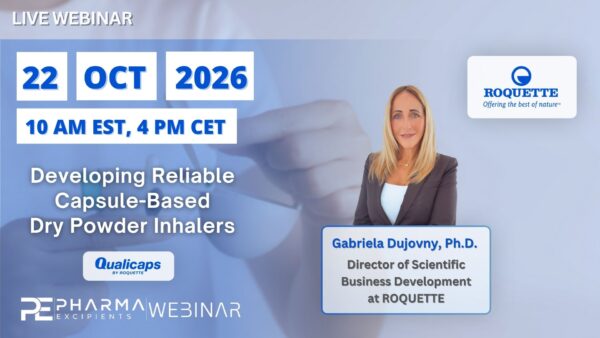
Enjoy our new free webinar, registration & information here:
Developing Reliable Capsule-Based Dry Powder Inhalers