- Suppliers




ADM 
Antares 
Armor Pharma 
Asahi KASEI 
Ashland 
BASF 
Beneo 
Captisol 
Clariant 
Croda 
DFE Pharma 
Dow 
Excipio Chemicals 
Fuji Chemical 
Gattefossé 
Gangwal 
Indovinya 
Ingredient Pharm 
IOI Oleo 
JRS Pharma 
KLK Oleo 
Lipoid 
Lubrizol Life Science Health 
MAGNESIA 
MEGGLE 
Mingtai Chemical 
Nagase Viita 
Nordic Bioproducts 
pharm-a-spheres 
PMC Isochem 
PQ 
Seppic 
ShinEtsu 
Sigachi 
SPI Pharma 
Südzucker 
Vikram Thermo 
Zerion Pharma  All4Nutra
- Suppliers
ADM Antares Armor Pharma Asahi KASEI Ashland BASF Beneo Captisol Clariant Croda DFE Pharma Dow Excipio Chemicals Fuji Chemical Gattefossé Gangwal Indovinya Ingredient Pharm IOI Oleo JRS Pharma KLK Oleo Lipoid Lubrizol Life Science Health MAGNESIA MEGGLE Mingtai Chemical Nagase Viita Nordic Bioproducts pharm-a-spheres PMC Isochem PQ Seppic ShinEtsu Sigachi SPI Pharma Südzucker Vikram Thermo Zerion Pharma - All4Nutra

Less known facts about Excipients: Xanthan Gum

Less known facts about Excipients #9: Xanthan Gum
This article is part of the “Less Known Facts About Excipients” series by Philippe Tschopp.
Xanthan Gum: A versatile thickener and stabilizer
Xanthan gum is one of the most widely used pharmaceutical and food hydrocolloids, yet very few people realize that it is produced by bacteria rather than extracted from plants.
Discovered in the 1950s, xanthan gum became one of the first commercially successful polysaccharides manufactured through industrial fermentation. Today, it is valued for its exceptional thickening, suspending and stabilizing properties in pharmaceutical formulations.
Xanthan gum is a high-molecular-weight extracellular polysaccharide produced by the bacterium Xanthomonas campestris. During fermentation, the microorganism converts simple carbohydrates into xanthan gum, which is secreted into the surrounding culture medium and subsequently recovered and purified.¹–³
How is pharmaceutical xanthan gum produced?
The manufacturing process consists of several carefully controlled steps:
- Fermentation Xanthomonas campestris is cultivated under aerobic conditions using carbohydrate sources such as glucose, sucrose or starch hydrolysates. During growth, the bacteria produce xanthan gum extracellularly.
- Cell Removal After fermentation, the bacterial cells are removed by centrifugation or filtration.
- Precipitation Xanthan gum is precipitated from the fermentation broth, typically using alcohol, to separate the polymer from the aqueous phase.
- Purification, Drying and Milling The purified xanthan gum is dried, milled and classified to obtain pharmaceutical-grade material meeting pharmacopeial specifications.¹–⁵
What makes xanthan gum unique?
Xanthan gum is composed of a cellulose-like backbone with trisaccharide side chains, giving it a highly ordered molecular structure that produces remarkable rheological properties.¹,⁶
Its most valuable pharmaceutical characteristics include:
- Extremely high viscosity at low concentrations
- Excellent suspension stability
- Strong shear-thinning behavior (pseudoplasticity)
- Broad pH stability
- Good thermal stability
- Compatibility with many pharmaceutical ingredients
One of its most important features is shear thinning: solutions become less viscous when shaken or pumped but rapidly recover their viscosity at rest. This makes xanthan gum particularly useful in oral suspensions and topical formulations.
Pharmaceutical applications
Pharmaceutical-grade xanthan gum is used in:
- Oral suspensions
- Topical gels
- Creams
- Ophthalmic formulations
- Controlled-release formulations
- Mucoadhesive systems
- Nutraceutical products¹,²
Its primary functions include:
- Thickening agent
- Suspending agent
- Stabilizer
- Gelling agent
- Controlled-release matrix former
Considerations for formulators
As a fermentation-derived excipient, xanthan gum offers excellent batch-to-batch consistency compared with many naturally harvested gums. It maintains stable viscosity over a broad pH range and remains effective in the presence of salts and temperature variations.
However, because of its high viscosity, careful optimization of concentration is required to achieve the desired flow properties and patient acceptability, particularly in oral liquid formulations.¹–⁴
Major pharmaceutical manufacturers
Examples of established manufacturers and suppliers include:
- CP Kelco
- Jungbunzlauer Suisse AG
- Cargill Incorporated
- Fufeng Group
- Deosen Biochemical Ltd.
Did you know?
Although xanthan gum is produced by bacteria, the final pharmaceutical-grade material contains no viable microorganisms. After fermentation, the polymer undergoes multiple purification steps before meeting pharmacopeial quality requirements.
Today, xanthan gum is produced in industrial fermenters with capacities of tens of thousands of liters, demonstrating how biotechnology has transformed naturally occurring microorganisms into reliable manufacturers of pharmaceutical excipients.
By Philippe Tschopp
Philippe Tschopp writes about pharmaceutical excipients, formulation and oral drug delivery, with a focus on excipient functionality, practical formulation considerations and lesser-known material properties.
Source:
- Rowe RC, Sheskey PJ, Quinn ME (Eds.). Handbook of Pharmaceutical Excipients. Pharmaceutical Press / American Pharmacists Association.
- European Pharmacopoeia (Ph. Eur.). Monograph: Xanthan Gum.
- United States Pharmacopeia–National Formulary (USP–NF). Monograph: Xanthan Gum.
- CP Kelco. Technical documentation for pharmaceutical-grade xanthan gum.
- Jungbunzlauer Suisse AG. Xanthan Gum Product Information and Technical Literature.
- García-Ochoa F, Santos VE, Casas JA, Gómez E. Xanthan Gum: Production, Recovery and Properties. Biotechnology Advances.
- Sworn G. Handbook of Hydrocolloids. Chapter on Xanthan Gum.
Disclaimer
This article is based on publicly available information and industry sources at the time of writing and supported by AI. While every effort has been made to ensure accuracy, completeness, and fair representation, the author does not guarantee that all information is current, error-free, or reflective of the latest developments.
The content is provided for informational and educational purposes only and does not constitute technical, regulatory, or commercial advice. No liability is accepted for decisions made based on this material. Readers are encouraged to consult the original manufacturers and official sources to verify details before making professional or business decisions.
Read also the other article from the series “Less known facts about…” here:
- Gum Arabic – Less known facts about: Gum Arabic
- Calcium Carbonate – Less known facts about: Calcium Carbonate
- Tragacanth – Less known facts about: Calcium Carbonate
- Magnesium Stearate – Less known facts about Excipients: Magnesium Stearate
Enjoy our new free webinar, registration & information here:
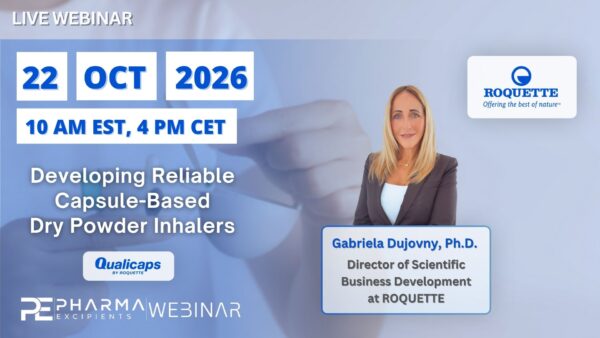
Developing Reliable Capsule-Based Dry Powder Inhalers