
- Suppliers

Biogrund 
Evonik 
Capsugel Lonza 
Roquette 
ADM 
Antares 
Armor Pharma 
Asahi KASEI 
Ashland 
BASF 
Beneo 
Captisol 
CarboHyde 
Clariant 
Croda 
DFE Pharma 
Dow 
Excipio Chemicals 
Fuji Chemical 
Gangwal 
Gattefossé 
Grace 
Indovinya 
Ingredient Pharm 
IOI Oleo 
JRS Pharma 
KLK Oleo 
Lactalis 
Lipoid 
Lubrizol Life Science Health 
MAGNESIA 
MEGGLE 
Mingtai Chemical 
Nagase Viita 
Nomisma 
Nordic Bioproducts 
PMC Isochem 
PQ 
Seppic 
ShinEtsu 
Sigachi 
SPI Pharma 
Vikram Thermo  All4Nutra
- Suppliers
Biogrund Evonik Capsugel Lonza Roquette ADM Antares Armor Pharma Asahi KASEI Ashland BASF Beneo Captisol CarboHyde Clariant Croda DFE Pharma Dow Excipio Chemicals Fuji Chemical Gangwal Gattefossé Grace Indovinya Ingredient Pharm IOI Oleo JRS Pharma KLK Oleo Lactalis Lipoid Lubrizol Life Science Health MAGNESIA MEGGLE Mingtai Chemical Nagase Viita Nomisma Nordic Bioproducts PMC Isochem PQ Seppic ShinEtsu Sigachi SPI Pharma Vikram Thermo - All4Nutra

Designing Oral Solid Drug Products to Minimize NDSRI Formation: Formulation Drivers, Mitigation Strategies and Lifecycle Control
Designing Oral Solid Drug Products to Minimize NDSRI Formation: Formulation Drivers, Mitigation Strategies and Lifecycle Control
Abstract
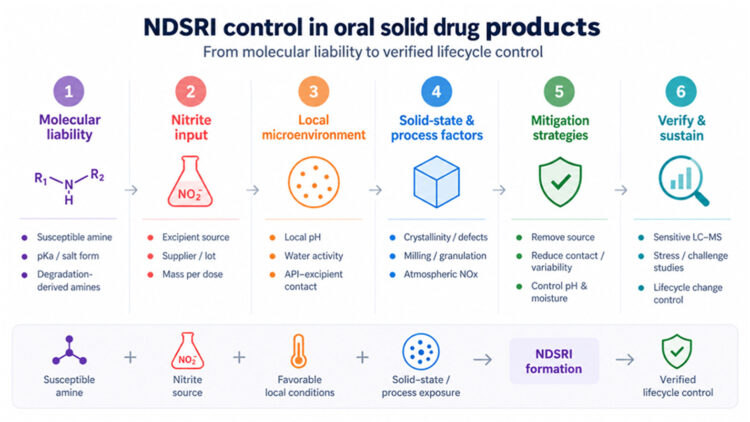
Nitrosamine drug substance-related impurities (NDSRIs) can form in oral solid drug products when a nitrosatable API or API-related amine encounters a nitrosating species within a favourable local microenvironment. This critical review examines the formulation and manufacturing variables that govern that encounter, including excipient-derived nitrite, supplier and lot variability, microenvironmental pH, water activity, salt form, solid-state (dis)order, granulation, particle engineering, manufacturing atmosphere, and storage. Evidence is distinguished as direct NDSRI drug-product evidence, transferable evidence from other pharmaceutical nitrosamine systems, general pharmaceutical-science evidence, or mechanistic inference. A simple formulation-level nitrite mass balance is included as a prioritisation aid for identifying dominant excipient contributions; it is not proposed as a validated predictor of NDSRI concentration.
Highlights
- Oral-solid NDSRI formation is framed as a controllable product-design problem.
- Evidence is ranked from direct drug-product data to mechanistic inference.
- Nitrite mass balance prioritises excipient and supplier control measures.
- Mitigation is ordered from source removal to scavengers and lifecycle control.
- Atomoxetine and miglustat illustrate reactive and proactive control strategies.
Mitigation options are evaluated against both their expected effect on nitrosation risk and their potential consequences for dissolution, stability, manufacturability, and bioequivalence. Integrated atomoxetine and miglustat case studies illustrate reactive and proactive control strategies. Overall, the evidence supports treating NDSRI prevention as a product-development and lifecycle-control problem in oral solid dosage forms, while also showing where recommendations remain provisional because direct product data are limited.
Ivana Šagud, Designing Oral Solid Drug Products to Minimize NDSRI Formation: Formulation Drivers, Mitigation Strategies and Lifecycle Control, Journal of Drug Delivery Science and Technology, 2026, 109036, ISSN 1773-2247,
https://doi.org/10.1016/j.jddst.2026.109036.
See our next webinar:
Elevate process, maximize flexibility: advanced QbD and Continuous Manufacturing for moisture-protective coatings


