
- Suppliers

Biogrund 
Evonik 
Capsugel Lonza 
Roquette 
ADM 
Antares 
Armor Pharma 
Asahi KASEI 
Ashland 
BASF 
Beneo 
Captisol 
CarboHyde 
Clariant 
Croda 
DFE Pharma 
Dow 
Excipio Chemicals 
Fuji Chemical 
Gangwal 
Gattefossé 
Grace 
Indovinya 
Ingredient Pharm 
IOI Oleo 
JRS Pharma 
KLK Oleo 
Lactalis 
Lipoid 
Lubrizol Life Science Health 
MAGNESIA 
MEGGLE 
Mingtai Chemical 
Nagase Viita 
Nomisma 
Nordic Bioproducts 
PMC Isochem 
PQ 
Seppic 
ShinEtsu 
Sigachi 
SPI Pharma 
Vikram Thermo  All4Nutra
- Suppliers
Biogrund Evonik Capsugel Lonza Roquette ADM Antares Armor Pharma Asahi KASEI Ashland BASF Beneo Captisol CarboHyde Clariant Croda DFE Pharma Dow Excipio Chemicals Fuji Chemical Gangwal Gattefossé Grace Indovinya Ingredient Pharm IOI Oleo JRS Pharma KLK Oleo Lactalis Lipoid Lubrizol Life Science Health MAGNESIA MEGGLE Mingtai Chemical Nagase Viita Nomisma Nordic Bioproducts PMC Isochem PQ Seppic ShinEtsu Sigachi SPI Pharma Vikram Thermo - All4Nutra

Optical coherence tomography as a process analytical technology for oral film formulations
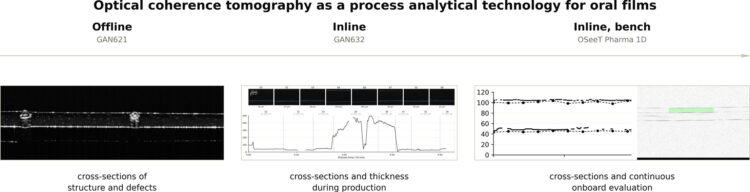
Optical coherence tomography as a process analytical technology for oral film formulations
Abstract
In oral film manufacturing, the dose of the active pharmaceutical ingredient is set by cutting the cast film into portions of defined area, which makes film thickness a critical quality attribute and an attractive target for calibration-free in-process measurement. This study evaluated Optical Coherence Tomography (OCT) to monitor film thickness of oral films along the offline-to-inline continuum.
A galvanometer-scanning spectral-domain OCT system, acquiring full two-dimensional cross-sections, was applied offline to cast films and inline above the moving, dried film of a continuous coating line. An OSeeT Pharma 1D sensor, which acquires depth profiles at a fixed lateral position and evaluates the interfaces within the instrument, was operated on a custom-built conveying bench reproducing continuous film movement. Offline, OCT resolved internal defects, including air bubbles, insoluble inclusions and the interlayer boundary of bilayer films. Preliminary observations further indicated its potential to detect storage-related microstructural changes.
OCT consistently yielded higher thickness values than a manually operated micrometer screw, with potential contributing factors, including film compression during contact measurement and the assumption of a constant refractive index, being discussed. Inline, thickness variations induced by deliberate variation of pump rate, coating knife height and liner speed were resolved for three different polymeric film formers, with thickness values extracted by post-processing of the recorded cross-sections, although evaluable frames were lost wherever the moving film left the set focal range. The OSeeT sensor returned stable thickness, roughness and homogeneity along the entire film length and reproduced the same systematic offset against the micrometer screw reference, delivering these values continuously and without post-processing.
Structural information therefore remains available alongside continuous monitoring if the acquisition is configured to retain it. The main obstacles to the use of OCT as an inline Process Analytical Technology in continuous oral film manufacturing therefore lie in system integration, i.e. mechanical film guidance, automated onboard evaluation and image retention, rather than in the optical performance of the instruments.
Highlights
- Optical Coherence Tomography was applied offline and inline to oral films.
- Cross-sections revealed air bubbles, particle inclusions and layer-layer interfaces.
- Proof of concept for sub-visual storage-induced changes.
- OCT thickness determination exceeded micrometer readings.
- Thickness monitoring and image retention are a configuration choice.
Introduction
Oral films sometimes also called oral strips have emerged as an advanced dosage form owing to their ease of administration, rapid onset of drug action, avoidance of the first-pass effect, and the potential for improved patient compliance.1,2 Administration without water and the need to swallow a solid bolus makes them particularly attractive for children, elderly patients and individuals with dysphagia.3,4 The industrial production of these film preparations performed by a (continuous) solvent casting process, requires stringent control to ensure uniformity in thickness and composition.5 As the final dose of the active pharmaceutical ingredient (API) is determined by cutting the cast film into portions of defined area determining the single dose, industrial process control most commonly focus on tracking the areal weight of the dried film, typically by sampling and weighing film sections at defined points throughout the manufacturing process.5,6
Measuring the film thickness offers a more direct route to the same information: unlike areal weight, it can in principle be measured non-destructively and inline, without removing or destroying film material, therefore providing continuous insight into how materials attributes and process parameters shape the physical structure of the produced film.7 Since uniformity of dosage units is a fundamental regulatory expectation for single-dose oral preparations, the precision of film thickness control and verification during manufacturing translates directly into dosing accuracy. A uniform thickness alone, however, does not guarantee a perfect film with the desired properties. Inadequate drying can lead to residual solvent content, which may cause subsequent precipitation of the API, affecting the drug release profiles.6 Moreover, imperfections, such as air bubbles or mechanical defects, can occur during film formation, potentially leading to weak spots or uneven distribution of the API.8 Neither areal weight determination nor contact thickness gauging reveals such internal features.
Process Analytical Technology (PAT) provides the framework for such measurements, enabling real-time monitoring and control of Critical Quality Attributes (CQAs) and immediate process adjustment. Recently, the regulatory relevance of PAT for continuous manufacturing has been reinforced through the adoption of ICH Q13 on the continuous manufacturing of drug substances and drug products.9 This aligns with a broader shift towards continuous pharmaceutical manufacturing, which supports uninterrupted production at reduced time and resource consumption forming a cornerstone of the Quality by Design framework.10,11
Among the available PAT tools, calibration-free techniques are of particular interest, as they provide direct, quantitative measurements of a physical property. Film thickness, for instance, can be obtained without a chemometric calibration model as required for near-infrared or Raman spectroscopy, which must first be calibrated against an independent reference method for each new formulation or process configuration.12, 13, 14 This distinction is particularly advantageous in a research and development context, where formulations and process conditions change frequently, and sample sizes are limited: a calibration-free tool can be applied directly to a new film composition without generating a calibration set from offline reference measurements first, shortening testing cycles and reducing the need for continued offline control. Optical Coherence Tomography (OCT) as an interferometric technique exemplifies such a calibration-free approach, providing direct measurements of film thickness, roughness, and homogeneity without additional chemometric modeling.15,16 Calibration-free tools are typically evaluated at technical, pilot and production scale.17 Applying them already in early-stage formulation and process development may therefore shorten pharmaceutical development timelines and reduce the risk of later failure.
OCT is a non-invasive, non-contact imaging technique based on low-coherence interferometry, in which light backscattered from interfaces within a sample is superimposed with light returning from a reference path to reconstruct depth-resolved cross-sections without contacting or altering the sample. A distinguishing feature is that axial and lateral resolutions are governed by independent physical parameters, namely the coherence length of the light source and the diffraction limit of the imaging optics.18 OCT has already been used in pharmaceutical research to assess film-coating thickness of tablets and uniformity in real time,15,19, 20, 21 to analyze the structure and thickness of microneedle patches,22 to monitor the structural integrity of bioresorbable implants and biomaterials,23 to identify packaging defects such as cracks, air pockets and seal irregularities,24 and to examine the uniformity of thin coatings on solid dosage forms.25, 26, 27
More recently, OCT has been used to characterize API-loaded buccal films, assessing their thickness and structural defects, such as air bubbles and delamination, in a non-destructive manner, while also tracking swelling and drug release over time. The authors identified the technique’s fast acquisition speed as promising for future inline use, although their own measurements were carried out offline in the laboratory.28 These applications underscore OCT’s value in enhancing pharmaceutical manufacturing precision and product quality.
Despite this broad application spectrum, OCT has, to our knowledge, not yet undergone a systematic evaluation for use with oral film preparations. Furthermore, its transition from predominantly offline laboratory instrument to a truly inline PAT method suitable for continuous film manufacturing has not been established.
In this study, we evaluated OCT for oral films across three levels of process integration. First, a scanning spectral-domain OCT system providing two-dimensional cross-sectional images was used offline to investigate the capability of the technique to resolve film thickness, internal structure and defects in finished films of different polymer composition (Section 2.3.1). Second, a comparable scanning OCT system was mounted at the continuous coating line, downstream to the drying section, to obtain inline measurements of the dried, moving film during processing (Section 2.3.2). Third, a dedicated industrial-grade OCT sensor designed for inline use, acquiring depth profiles at a fixed lateral position, was operated on a custom-built conveying bench, reproducing the continuous movement of the film close to the probe, enabling its performance to be assessed under controlled conditions prior to transfer to an industrial line (Section 2.3.3). By comparing the results obtained at each of these three stages, this work establishes the applicability and the limitations of OCT as a non-invasive PAT tool for oral film manufacturing and assesses the extent to which offline feasibility translates into reliable inline performance.
Download the full article as PDF here Optical coherence tomography as a process analytical technology for oral film formulations
or continue reading here
Materials
For the offline measurements, six polymeric systems were evaluated including hydroxypropyl methylcellulose (Hypromellose, HPMC, Pharmacoat 606, Shin Etsu, Tokyo, Japan), hydroxypropyl cellulose (HPC, Klucel EFL, Ashland, Düsseldorf, Germany), polyvinyl alcohol (PVA, Emprove 18-88, Merck, Darmstadt, Germany), carboxymethyl cellulose (Carmellose sodium, CMC, Blanose C, Ashland, Düsseldorf, Germany), polyvinyl pyrrolidone (PVP; Kollidon K 90, BASF, Ludwigshafen am Rhein, Germany) and ethyl cellulose (EC, Aqualon, N22, Ashland, Düsseldorf, Germany). For the inline measurements, drug-free HPC, PVP and HPMC films were analyzed; for the simulated inline measurements, PVA and HPMC films were cast at two nominal target thicknesses each. In all formulations, glycerol was employed as a plasticizer to enhance film flexibility, while distilled water served as the primary solvent. For films containing PVA, a 50:50 mixture of distilled water and ethanol was used to improve solubility and film formation. For EC-based films, ethanol was exclusively used as solvent due to the polymer’s insolubility in water.
Leonie-Lara Dorothea Uth, Matthias Wolfgang, Stefan Klinken-Uth, Johannes Khinast, Joerg Breitkreutz, Optical coherence tomography as a process analytical technology for oral film formulations, Journal of Pharmaceutical Sciences, 2026, 104582, ISSN 0022-3549, https://doi.org/10.1016/j.xphs.2026.104582.
Are you looking for excipients in commercial quantities?


