
- Suppliers





ADM 
Antares 
Armor Pharma 
Asahi KASEI 
Ashland 
BASF 
Beneo 
Captisol 
Clariant 
Croda 
DFE Pharma 
Dow 
Excipio Chemicals 
Fuji Chemical 
Gattefossé 
Gangwal 
Indovinya 
Ingredient Pharm 
IOI Oleo 
JRS Pharma 
KLK Oleo 
Lipoid 
Lubrizol Life Science Health 
MAGNESIA 
MEGGLE 
Mingtai Chemical 
Nagase Viita 
Nordic Bioproducts 
pharm-a-spheres 
PMC Isochem 
PQ 
Seppic 
ShinEtsu 
Sigachi 
SPI Pharma 
Südzucker 
Vikram Thermo 
Zerion Pharma  All4Nutra
- Suppliers
ADM Antares Armor Pharma Asahi KASEI Ashland BASF Beneo Captisol Clariant Croda DFE Pharma Dow Excipio Chemicals Fuji Chemical Gattefossé Gangwal Indovinya Ingredient Pharm IOI Oleo JRS Pharma KLK Oleo Lipoid Lubrizol Life Science Health MAGNESIA MEGGLE Mingtai Chemical Nagase Viita Nordic Bioproducts pharm-a-spheres PMC Isochem PQ Seppic ShinEtsu Sigachi SPI Pharma Südzucker Vikram Thermo Zerion Pharma - All4Nutra

The Role of In Vitro Model Complexity in Lipid-Based Formulation Screening: A Case Study with Ticagrelor
The Role of In Vitro Model Complexity in Lipid-Based Formulation Screening
Abstract
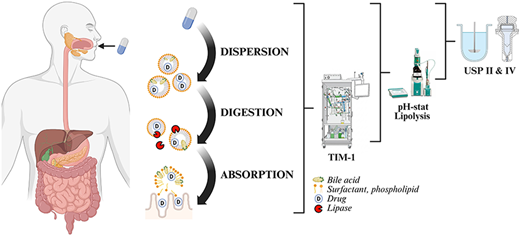
Lipid-based formulations (LBFs) offer a promising strategy to enhance the oral bioavailability of poorly water-soluble drugs, such as biopharmaceutical classification system (BCS) Class IV compounds. However, their in vitro characterization remains challenging because of the complex interplay between dispersion, dissolution, lipid digestion, and absorption. In this study, several LBFs of ticagrelor were investigated using a progressive set of in vitro models of increasing physiological complexity, including dissolution testing in biorelevant media using USP II and USP IV apparatuses, intestinal and gastrointestinal lipolysis assays, and a dynamic gastrointestinal model (TIM-1).
The aim of this study was to evaluate the capabilities and limitations of each method and examine how increasing model complexity and experimental setup influences formulation performance and relative ranking. The results showed that the formulation ranking was strongly method-dependent. Under biorelevant conditions, USP II and USP IV generated distinct release kinetics but similar rankings with minimal differences observed between the LBFs. In contrast, lipolysis experiments highlighted the impact of lipid digestion, with the inclusion of a gastric phase increasing intestinal drug availability.
TIM-1 provided unique insights into LBF behavior under dynamic gastrointestinal conditions, capturing the combined effects of digestion, transit, and absorption. Overall, the observed model-dependent ranking emphasizes the importance of combining complementary in vitro approaches to achieve a mechanistic and robust characterization of lipid-based formulations and to support future IVIVC development.
Introduction
Lipid-based formulations (LBFs) have emerged as powerful strategies to enhance the oral bioavailability of poorly water-soluble drugs. Among the biopharmaceutical classification system (BCS), class IV compounds represent the most challenging group due to their combined low solubility and limited intestinal permeability. (1) For these compounds, it may be necessary to optimize the formulation to ensure adequate in vivo absorption, and lipid-based formulations may be an appropriate choice to overcome solubility and permeability issues. However, during the development of this formulation, having predictive in vitro and in silico tools for in vivo performance prediction can facilitate pharmaceutical development by reducing the number of products tested in preclinical and clinical studies.
Among BCS class IV compounds, ticagrelor, a P2Y12 receptor antagonist used as an antiplatelet agent, exhibits both low aqueous solubility and limited intestinal permeability, leading to a poor oral bioavailability. After oral administration, its absolute bioavailability is approximately 0.36. (2) Lipid-based delivery systems, such as self-emulsifying drug delivery systems (SEDDS), have been explored to enhance its solubilization and, consequently, improve oral absorption. (3−5)
In recent years, significant progress has been made in developing in vitro tools to predict the in vivo fate of LBFs. Despite the increasing availability of advanced in vitro techniques to evaluate LBFs, their ability to reliably predict oral absorption remains uncertain. Lipid excipients undergo digestion, solubilization, and structural transformations in the gastrointestinal tract. Moreover, some excipients are known to promote absorption or lymphatic transport. (6−8) As a result, simplified in vitro models often fail to fully capture the complex sequences of events occurring in vivo.
Standard dissolution tests, such as USP Apparatus II (paddle) and USP Apparatus IV (flow-through cell), are commonly used to monitor drug release under controlled hydrodynamic conditions. USP Apparatus II, in particular, is the most widely employed tool for establishing in vitro–in vivo correlations (IVIVCs) for LBFs. (9) These tests can be performed in simple pharmacopeia buffer media or in biorelevant media such as FaSSIF and FeSSIF, which reproduce the components of intestinal fluids, and have been shown to improve the prediction of in vivo solubilization. (10) Beyond dissolution, in vitro lipolysis models are widely employed to simulate the enzymatic digestion of lipid formulations. Intestinal lipolysis is the most frequently used method, replicating the action of pancreatic lipase and bile salts to assess drug solubilization and excipients digestion during the intestinal phase. (11−15) Combined gastric and intestinal lipolysis, which includes a preceding gastric step, can modify the solubilization and digestion profile and provides complementary information that may better reflect the fate of formulations in vivo. (16) Although lipolysis is one of the most commonly used methods for characterizing LBFs, it has been shown that, in most cases, only a rank-order correlation (level D) can be established, without a real quantitative mathematical correlation to in vivo absorption. (9) Finally, more complex systems such as TIM-1 have been developed, as they account not only for solubilization and digestion but also for gastric and intestinal secretions, gastric motility and peristalsis, and the different compartments of the gastrointestinal tract. (17, 18) However, despite their high level of physiological relevance, such dynamic gastrointestinal model have been rarely published to evaluate and predict the in vivo performance of LBFs.
In this study, we investigated how increasing the in vitro model complexity influences the ranking of ticagrelor lipid-based formulations across a panel of biorelevant tools commonly used in academic and industrial pharmaceutical research. These tools were applied in a stepwise manner with increasing physiological complexity, ranging from basic dispersion and dissolution under biorelevant conditions to enzyme-based intestinal and gastrointestinal digestion tests and a dynamic gastrointestinal model. For each model, formulation ranking was established based on intestinal performance, corresponding to the primary site of drug absorption, allowing a direct comparison of ranking outcomes across models of increasing complexity. This comparative framework supports a mechanistic interpretation of formulation performance and provides a structured basis for formulation screening, decision making, and the exploration of potential IVIVCs.
Download the full article as PDF here The Role of In Vitro Model Complexity in Lipid-Based Formulation Screening
or continue reading here
Materials
Ticagrelor was obtained from Chanyoo Pharmaceutical Co., Ltd. (Nantong, Jiangsu, China). Tween 80, pepsin, amano lipase PS, pancreatin, trypsin, bovine bile, 4-bromophenylboronic acid, l-α-phosphatidylcholine, sodium taurodeoxycholate, tris(hydroxymethyl)aminomethane (Tris), calcium chloride, and sodium bicarbonate were purchased from Sigma-Aldrich (Merck KGaA, Darmstadt, Germany). Acetonitrile, methanol, and sodium chloride were purchased from VWR International (Radnor, PA). Formic acid was obtained from Fisher Chemicals (300 Industry Drive, Pittsburgh, PA). The gastric enzyme RGE-15 was purchased from Lipolytech (Marseille, France). Fasted State Simulated Intestinal Fluid-V2 (FaSSIF-V2) and Fasted State Simulated Gastric Fluid (FaSSGF) were purchased from Biorelevant Ltd. (London, U.K.). Labrasol ALF (caprylocaproylmacrogol-8 glycerides), Transcutol HP (diethylene glycol monoethyl), Labrafac MC60 (glyceryl mono and dicaprylocaprate), and Maisine CC (glyceryl monolinoleate) were kindly provided by Gattefossé Co. (Saint-Priest, France).
All chemicals and solvents used in this study were of analytical grade. Distilled water was used throughout the experiments.
Arnaud Bourderi-CambonKhaled FadhlaouiManon RossanoSandrine ChalanconCathérine DhainautStéphanie ChevrierDiane SchneiderSylvain DenisPhilippe CaisseEric Beyssac; The Role of In Vitro Model Complexity in Lipid-Based Formulation Screening: A Case Study with Ticagrelor. ACS Omega 2026; https://doi.org/10.1021/acsomega.6c08404
Are you looking for excipients in commercial quantities?


