- Suppliers




ADM 
Antares 
Armor Pharma 
Asahi KASEI 
Ashland 
BASF 
Beneo 
Captisol 
Clariant 
Croda 
DFE Pharma 
Dow 
Excipio Chemicals 
Fuji Chemical 
Gattefossé 
Gangwal 
Indovinya 
Ingredient Pharm 
IOI Oleo 
JRS Pharma 
KLK Oleo 
Lipoid 
Lubrizol Life Science Health 
MAGNESIA 
MEGGLE 
Mingtai Chemical 
Nagase Viita 
Nordic Bioproducts 
pharm-a-spheres 
PMC Isochem 
PQ 
Seppic 
ShinEtsu 
Sigachi 
SPI Pharma 
Südzucker 
Vikram Thermo 
Zerion Pharma  All4Nutra
- Suppliers
ADM Antares Armor Pharma Asahi KASEI Ashland BASF Beneo Captisol Clariant Croda DFE Pharma Dow Excipio Chemicals Fuji Chemical Gattefossé Gangwal Indovinya Ingredient Pharm IOI Oleo JRS Pharma KLK Oleo Lipoid Lubrizol Life Science Health MAGNESIA MEGGLE Mingtai Chemical Nagase Viita Nordic Bioproducts pharm-a-spheres PMC Isochem PQ Seppic ShinEtsu Sigachi SPI Pharma Südzucker Vikram Thermo Zerion Pharma - All4Nutra

The solid dispersion of a novel curcumin analogue (CACN136) prepared using PVP/Mannitol composite carrier significantly improved oral bioavailability and depression-like behavior in mice

The solid dispersion of a novel curcumin analogue (CACN136) prepared using PVP/Mannitol composite carrier significantly improved oral bioavailability and depression-like behavior in mice
Abstract
Objective
Methods
Results
Conclusion
CACN136-SD improved the solubility, dissolution, and oral exposure of CACN136 and showed enhanced antidepressant-like activity associated with changes in monoamine-related markers. This solid dispersion represents a promising antidepressant candidate with potential for clinical translation.
Highlights
- CACN136-SD increased CACN136 solubility and rapid dissolution.
- Solid dispersion enhanced CACN136 oral bioavailability in rats.
- CACN136-SD improved depression-like behaviors in CUMS mice.
- CACN136-SD regulated brain 5-HT and MAO without obvious toxicity.
Introduction
Major Depressive Disorder (MDD) is a chronic and recurrent psychiatric disorder, with an estimated lifetime prevalence of approximately 17% (Kessler et al., 2003). Its clinical manifestations are diverse, primarily including depressed mood, anhedonia, anxiety, sleep disturbances, hopelessness, loss of appetite, and in severe cases, suicidal behavior (Arias-de la Torre et al., 2021). It is projected that by 2030, depression will become the leading cause of the global disease burden (Mathers and Loncar, 2006).
Conventional antidepressant drugs, such as selective serotonin reuptake inhibitors (e.g., fluoxetine) and serotonin-norepinephrine reuptake inhibitors (e.g., venlafaxine), exert their effects primarily by modulating monoaminergic neurotransmitters. However, these agents typically exhibit a slow onset of action and are ineffective in approximately two-thirds of patients (Blokhin et al., 2020, Jakobsen et al., 2017). In recent years, natural product monomers have shown promising antidepressant potential due to their multi-target synergistic mechanisms (Hu et al., 2024, Liu et al., 2022, Sheng et al., 2023). Among these, curcumin has attracted attention for its excellent antidepressant and neuroprotective effects (Chen et al., 2025b, Zhang et al., 2025a, Zhang et al., 2025b); however, its extremely low solubility and instability severely limit its clinical application (Wang et al., 2026).
To address the limitations of curcumin, our team has successfully developed a novel curcumin analogue, designated as CACN136. Previous studies have confirmed its significant antidepressant effects (Chen et al., 2025a). Compared with curcumin, CACN136 exhibits stronger ABTS radical scavenging activity, superior anti-oxidative stress capacity exceeding that of vitamin C, and low neurotoxicity. In the chronic unpredictable mild stress (CUMS) mouse model, CACN136 significantly reversed depressive-like behaviors, and its mechanism may involve activation of the Keap1-Nrf2/BDNF-TrkB signaling pathway and inhibition of 5-HT metabolism. These findings suggest that CACN136 holds potential as a novel antidepressant candidate (Chen et al., 2025a).
Nevertheless, the relatively low solubility of this compound (150.4 mg/L) may limit its absorption and therapeutic efficacy to a certain extent. Solid dispersion (SD) technology is an established strategy for improving the apparent solubility and oral performance of poorly soluble crystalline drugs (Kapourani et al., 2025, Kim et al., 2021, Petersen et al., 2024). Other formulation strategies, including self-emulsifying drug delivery systems, polymeric micelles, and salt formation, may also enhance oral absorption, but their suitability depends on the physicochemical properties of the drug(Hwang et al., 2020, Nyamba et al., 2024, Tarumi et al., 2025).
Self-emulsifying systems require sufficient drug solubility in lipids and surfactants and may allow precipitation after gastrointestinal dilution(Salawi, 2022). Polymeric micelles require stable drug–core interactions and resistance to dilution, whereas salt formation requires suitable ionizable groups as well as adequate chemical and physical stability(Hiew and Taylor, 2022, Hwang et al., 2020). For CACN136, the primary pharmaceutical challenges are its low aqueous solubility and highly crystalline structure, while its suitability for salt-, lipid-, or micelle-based formulations has not been established. A solid dispersion was therefore selected to reduce the crystal-lattice barrier, improve wettability, and promote drug dispersion in aqueous media.
PVP K30 was selected as the polymeric carrier because its hydrophilic, amorphous structure can facilitate molecular dispersion and inhibit drug nucleation and recrystallization(Wdowiak et al., 2024). Mannitol was included as a hydrophilic auxiliary carrier to improve wettability, medium penetration, powder dispersion, and handling properties(Poka et al., 2023). The two carriers were selected for their complementary pharmaceutical functions rather than their novelty. Their proportions were optimized through single-factor experiments and an L9 orthogonal design, followed by verification in three independent batches.
This study aimed to develop and evaluate a PVP K30/mannitol-based solid dispersion of CACN136. We hypothesized that dispersing CACN136 in a predominantly amorphous or highly disordered state within a hydrophilic carrier matrix would improve its wettability and dissolution, thereby increasing oral exposure and antidepressant-like activity. A candidate formulation was selected through single-factor screening and an L9 orthogonal design and verified in three independent batches. Its solid-state properties and morphology were characterized by differential scanning calorimetry, X-ray powder diffraction, Fourier-transform infrared spectroscopy, and scanning electron microscopy.The apparent solubility, dissolution behavior, and oral pharmacokinetic profile of CACN136-SD were subsequently compared with those of the unformulated CACN136 API. Antidepressant-like activity, serum and hippocampal 5-hydroxytryptamine and monoamine oxidase levels, and preliminary safety were further evaluated in a chronic unpredictable mild stress mouse model. By linking formulation performance with pharmacokinetic and pharmacodynamic outcomes, this study provides a pharmaceutical rationale for the further preclinical development of CACN136 and identifies key questions that should be addressed before clinical translation.
Download the full article as PDF here The solid dispersion of a novel curcumin analogue
or continue reading here
Materials
The chemical structure of CACN136 is shown in Fig. 1. CACN136, a methyl monocarbonyl curcumin analogue, was synthesized through a double-condensation reaction between 4-piperidone and 3,5-dimethyl-4-hydroxybenzaldehyde, followed by purification and structural characterization, as described in our previous study(Chen et al., 2025a). The present study used the previously synthesized and characterized compound and focused on the development and evaluation of its solid-dispersion formulation. PVP K30, mannitol, and fluoxetine hydrochloride were purchased from Aladdin (Shanghai, China). All other chemicals were of chromatographic grade.
Yumeng Wei, Ke Gong, Rongzhu Li, Qiong Zhang, Yueting Zhong, Wenmei Zhao, Ying Zuo, Shifeng Chue, Ling Zhao, The solid dispersion of a novel curcumin analogue (CACN136) prepared using PVP/Mannitol composite carrier significantly improved oral bioavailability and depression-like behavior in mice, International Journal of Pharmaceutics, Volume 704, 2026, 127420, ISSN 0378-5173, https://doi.org/10.1016/j.ijpharm.2026.127420.
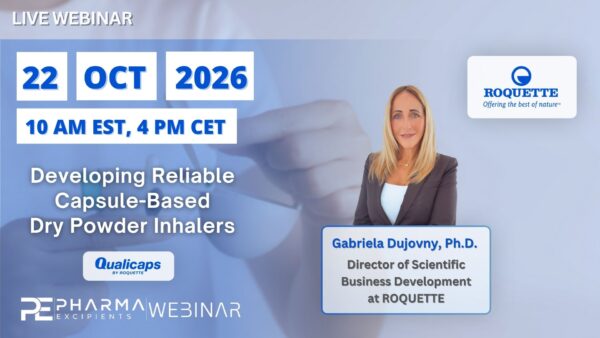
Enjoy our new free webinar, registration & information here:
Developing Reliable Capsule-Based Dry Powder Inhalers